






What's Happening?
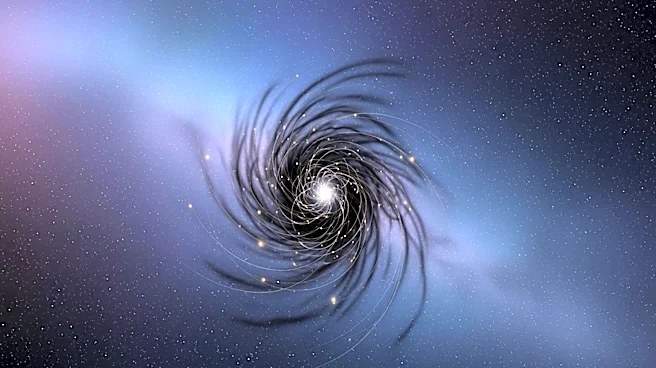
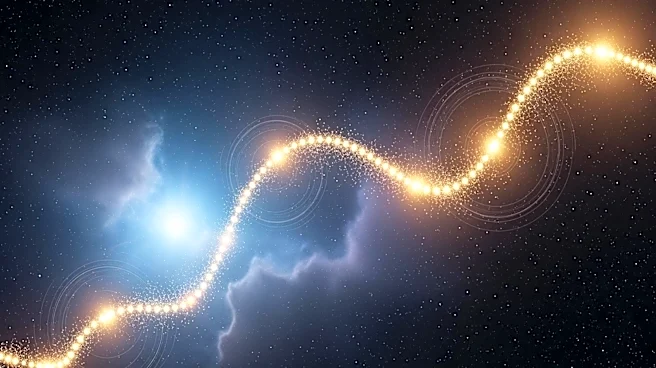
Physicists from the US, UK, and Europe propose that dark matter may have been accidentally detected in gravitational wave data from 2019. The researchers suggest that if two black holes collided while enveloped in a cloud of dark matter, the gravitational waves
emitted could carry the imprint of that environment. This hypothesis was tested against dozens of gravitational wave detections, revealing one event that potentially fits the criteria. Although not confirmed, this finding could open new avenues for investigating both gravitational waves and dark matter. The study highlights the potential of using black holes to probe dark matter at smaller scales than previously possible.
Why It's Important?
The potential detection of dark matter through gravitational waves could revolutionize the understanding of this elusive substance, which is believed to make up a significant portion of the universe's mass. This discovery could lead to new methods of studying dark matter, providing insights into its properties and interactions. The implications extend to astrophysics and cosmology, potentially affecting theories about the universe's structure and evolution. If confirmed, this method could offer a novel approach to exploring dark matter, which has remained largely undetectable through traditional means.
What's Next?
Further research and independent verification are necessary to confirm the presence of dark matter in gravitational wave data. The scientific community may conduct additional studies to refine models and improve detection methods. If validated, this approach could become a standard tool in astrophysics, enhancing the ability to study dark matter and its role in the universe. The findings may also prompt a reevaluation of existing gravitational wave data to identify other potential dark matter signatures.