





What's Happening?
The Indiana Economic Development Corporation has granted final approval for spending to commence on the Whitewater Canal State Historic Site Preservation Project. This approval paves the way for the engineering design process to begin in the coming weeks.
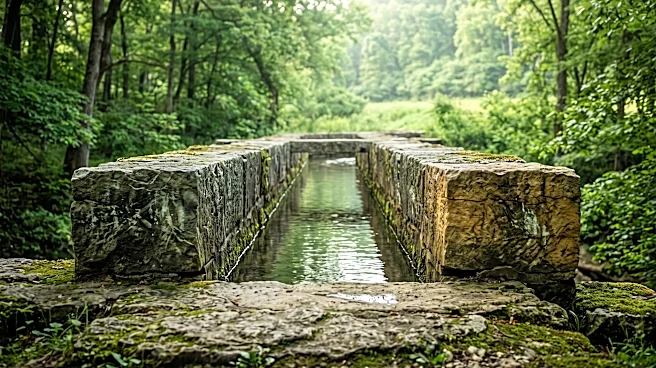
The design phase will identify the necessary work to preserve key historical structures, including the Duck Creek Aqueduct, Laurel Feeder, and Lock 24. It will also help the Whitewater Canal Historic Site establish project timelines and an operational sequence for the upcoming construction. This multi-year restoration effort, valued at $14.4 million, ultimately aims to reintroduce a canal boat experience to the Whitewater Canal. The project received a significant boost in January with a $7 million matching grant commitment from the state, followed by an additional $7.4 million approved by the Indiana State Budget Committee in April. The current restoration project was initiated after a 2022 site evaluation and environmental review revealed significant deterioration and erosion within the canal, following an incident where the Ben Franklin III Canal Boat was damaged during transportation for a five-year inspection.
Why It's Important?
This project is crucial for the preservation of Indiana's historical infrastructure and cultural heritage. The Whitewater Canal State Historic Site represents a significant piece of the state's past, and its restoration will ensure that future generations can experience and learn from this historical waterway. Economically, the restoration could boost local tourism by re-establishing the canal boat experience, attracting visitors to the Metamora area and supporting local businesses. The substantial state investment, totaling $14.4 million, underscores the importance placed on historical preservation and its potential for economic revitalization. The project's multi-year nature also suggests sustained economic activity and job creation in the region. Furthermore, the detailed engineering design process will provide valuable insights into effective preservation techniques for similar historical sites, potentially setting a precedent for future restoration efforts across the state and beyond.
What's Next?
With the approval for spending now in place, the immediate next step is the commencement of the engineering design process. This phase will be critical in determining the specific scope of work required for the Duck Creek Aqueduct, Laurel Feeder, and Lock 24, as well as establishing a detailed timeline and order of operations for the construction phase. While a complete project timeline has not yet been determined, the multi-year nature of the restoration suggests that construction will proceed in phases. Stakeholders, including the Indiana Economic Development Corporation and the Whitewater Canal State Historic Site, will likely provide updates as the design process progresses and construction milestones are reached. The ultimate goal is to restore the canal to a condition that allows for the reintroduction of a canal boat, which will be a significant future development for the historic site.
Beyond the Headlines
Beyond the immediate restoration, this project highlights the ongoing challenge and importance of preserving historical infrastructure in the face of natural deterioration and aging. The incident with the Ben Franklin III Canal Boat and the subsequent discovery of widespread erosion underscore the need for continuous monitoring and proactive maintenance of such sites. The project also reflects a broader societal value placed on historical education and experiential learning, as the reintroduction of a canal boat aims to provide an immersive historical experience. This initiative could serve as a model for other states grappling with the preservation of their own historical waterways and industrial heritage, demonstrating how significant investment and careful planning can breathe new life into historical assets, transforming them into educational and economic drivers.