








What's Happening?
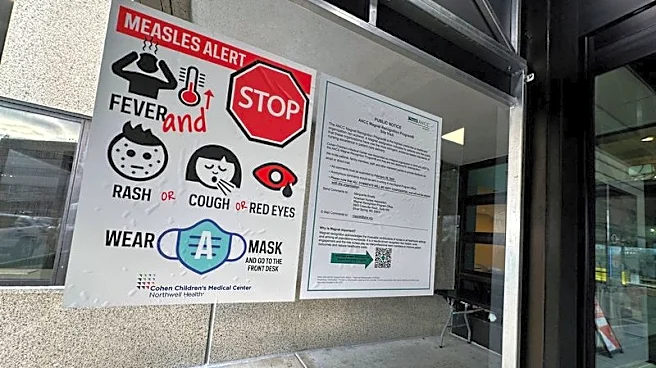
A detailed explanation of measles symptoms outlines the progression of the illness, emphasizing that individuals are contagious before the characteristic rash appears. The initial phase of measles often mimics a common cold, presenting with a fever, cough,
runny nose (coryza), and red, watery eyes (conjunctivitis), collectively known as the 'three Cs.' The fever can be high and may increase over several days. The rash typically emerges days after these initial symptoms, starting at the hairline and spreading downwards. During the period between exposure and the appearance of the rash, which can be one to two weeks, an infected person can unknowingly transmit the virus to others. The timeline distinguishes between 'days since exposure' and 'days since the first symptom' to help track the illness.
Why It's Important?
Understanding the day-by-day progression of measles, particularly the contagious period before the rash, is crucial for public health in the U.S. This knowledge helps parents, educators, and healthcare providers identify potential cases early and take appropriate isolation measures, thereby preventing wider outbreaks. The delay in visible symptoms means that infected individuals can spread the virus unknowingly, making contact tracing and rapid response challenging. Highlighting the 'three Cs' and persistent fever as early indicators can prompt earlier medical consultation and testing, which is vital given the highly contagious nature of measles. This information also reinforces the importance of vaccination, as the MMR vaccine offers protection and can even provide some benefit if administered shortly after exposure.
What's Next?
Public health agencies will likely continue to disseminate detailed information about measles symptoms and transmission to increase public awareness. Healthcare providers will be encouraged to consider measles in patients presenting with cold-like symptoms, especially if there's a history of potential exposure or travel. Educational campaigns may focus on the importance of vaccination and the need to call ahead before visiting clinics with suspected cases to prevent further spread. The ongoing threat of measles outbreaks, particularly in communities with lower vaccination rates, necessitates continuous vigilance and clear communication from health authorities to mitigate the impact of the disease.
Beyond the Headlines
The detailed symptom timeline for measles underscores a broader challenge in public health: managing diseases with asymptomatic or non-specific early stages. This characteristic of measles highlights the critical role of herd immunity, as individuals who are unknowingly contagious can easily spread the virus in unvaccinated populations. The emphasis on early symptoms also serves as a reminder of the importance of basic public health practices, such as staying home when sick and seeking medical advice. Furthermore, the information implicitly addresses vaccine hesitancy by demonstrating the real-world consequences of a highly transmissible disease, reinforcing the scientific consensus on the effectiveness of vaccination as a primary preventive measure against measles and its potential complications.