
What's Happening?
Astronomers using the NASA/ESA Hubble Space Telescope have observed a significant event in the Fomalhaut star system, witnessing for the first time a collision between massive objects. This discovery was
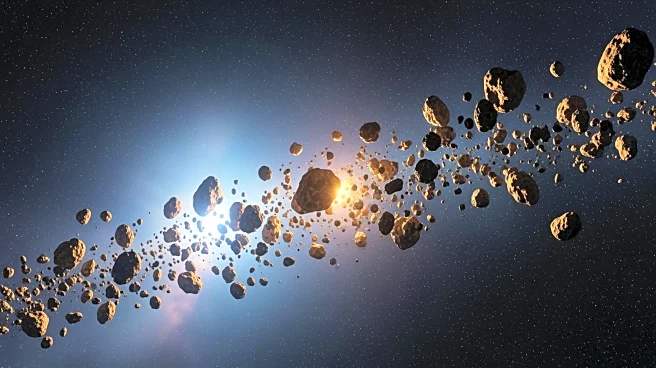
made while observing the bright star Fomalhaut, located 25 light-years from Earth in the constellation Piscis Austrinus. The system, which is more massive and brighter than the Sun, is surrounded by several belts of dusty debris. The collision resulted in a large debris cloud, marking a rare opportunity to study such events. Previously, in 2008, Hubble discovered a candidate planet around Fomalhaut, which now appears to be a dust cloud from colliding planetesimals. The recent observations revealed a second point of light, named 'circumstellar source 2' (cs2), near the first object, 'cs1'. These findings suggest a dynamic upheaval in the Fomalhaut system, similar to early conditions in our solar system.
Why It's Important?
The observation of these collisions provides critical insights into the evolution of planetary systems. Such events are fundamental yet rare, making them difficult to study. The data allows researchers to estimate the size and number of colliding bodies, offering a glimpse into the composition and formation of planetesimals. This information is crucial for understanding the processes that shape planetary systems. The findings also serve as a cautionary tale for future space missions, as dust clouds like cs1 and cs2 can be mistaken for planets. This underscores the need for careful analysis in the search for extrasolar planets. The study of these collisions could inform the design and interpretation of future astronomical observations, potentially impacting the field of exoplanet research.
What's Next?
The research team, led by Paul Kalas, has been granted additional Hubble time to monitor cs2 over the next three years. They aim to observe changes in its shape, brightness, and orbit, which could provide further insights into the dynamics of the Fomalhaut system. The team will also utilize the James Webb Space Telescope's NIRCam instrument to gather more data, including the size and composition of the dust grains. This multi-spectral investigation will enhance the understanding of the system's rapid evolution. The ongoing study could reveal more about the frequency and nature of such collisions, contributing to the broader knowledge of planetary system development.