





What's Happening?
Astronomers have resolved a long-standing mystery surrounding Gamma Cassiopeiae, a massive B-type star located approximately 549 light-years away. Known for its rapid rotation and the formation of a glowing hydrogen disk, Gamma Cas has been a subject
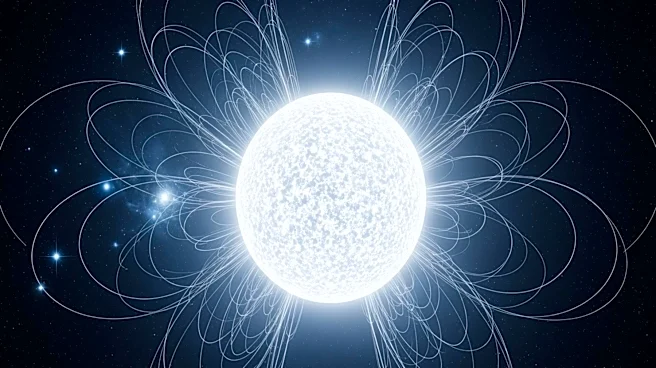
of intrigue due to its intense X-ray emissions, which are 40 times stronger than those of similar stars. Recent high-precision observations have revealed that these X-rays are not emitted by Gamma Cas itself but by a lower-mass companion star, a magnetic white dwarf. The X-rays are generated as material from Gamma Cas's hydrogen disk flows towards the white dwarf, forming a disk around it. This material follows magnetic field lines to the white dwarf's poles, where it heats up and emits the observed X-rays.
Why It's Important?
This discovery is significant as it enhances the understanding of Be-type stars and their interactions with companion stars. The findings provide insights into the dynamics of star systems with massive stars and white dwarfs, contributing to the broader field of stellar astrophysics. Understanding such interactions is crucial for comprehending the life cycles of stars and the evolution of binary systems. The study also highlights the importance of high-precision astronomical observations in unraveling complex stellar phenomena, potentially influencing future research methodologies and technologies in the field.
What's Next?
Further studies are likely to focus on similar Be-type star systems to determine if the observed phenomena in Gamma Cas are common among such stars. Astronomers may also explore the implications of these findings on the formation and evolution of binary star systems. Additionally, advancements in observational technology could lead to more detailed studies of the interactions between massive stars and their companions, potentially uncovering new aspects of stellar behavior and evolution.
Beyond the Headlines
The discovery underscores the complexity of stellar systems and the intricate processes that govern their behavior. It also raises questions about the role of magnetic fields in shaping the interactions between stars and their companions. The study of Gamma Cas and its companion could lead to a deeper understanding of the mechanisms driving X-ray emissions in other astronomical objects, such as neutron stars and black holes, thereby broadening the scope of astrophysical research.