



What's Happening?
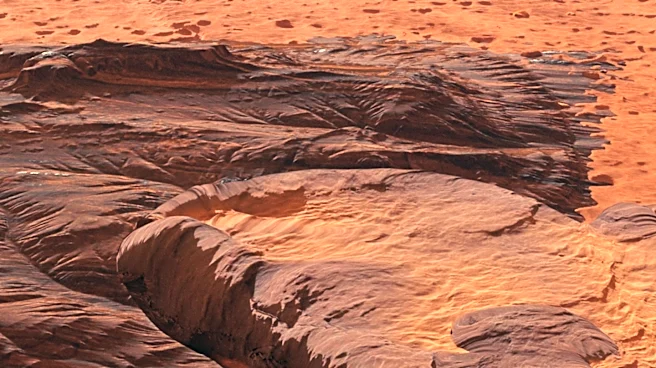
A new image captured by the European Space Agency's (ESA) Mars Express spacecraft has revealed prominent windblown ridges, known as yardangs, on the surface of Mars. These geological formations are visible as wrinkled sections on the left and right sides
of the image, specifically in the Amazonis Mensa region. According to an ESA statement accompanying the image, these yardangs are formed by the erosive power of wind, which whips up loose sand particles, effectively sandblasting the Martian landscape. The image also shows large, round craters from ancient impacts, many of which have been partially filled by lava flows approximately three billion years ago. The presence of yardangs rippling in different directions indicates how Amazonis Mensa acts as a windbreak, influencing the orientation of wind-blown material.
Why It's Important?
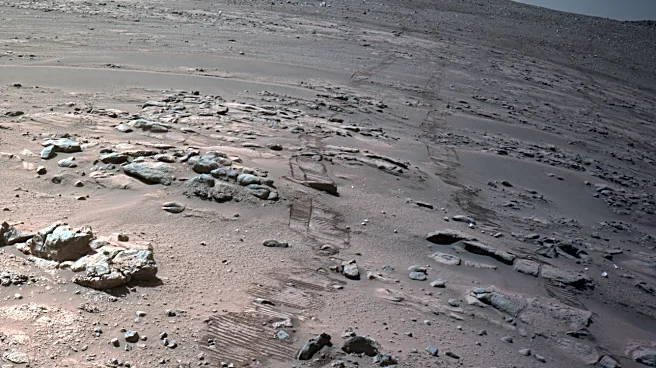
This image provides planetary scientists with crucial insights into the powerful erosive forces that have continuously shaped and reshaped the surface of Mars over vast geological timescales. The observation of yardangs, alongside impact craters and ancient lava flows, offers a comprehensive view of the Red Planet's dynamic geological history. Understanding these processes is vital for deciphering Mars's past climate, atmospheric conditions, and potential for past or present habitability. The Mars Express mission, which has been providing data for over two decades, continues to contribute significantly to our knowledge of Martian geomorphology, helping scientists to better comprehend how planetary surfaces evolve under different environmental conditions.
What's Next?
Scientists will continue to analyze images and data from the Mars Express spacecraft to further understand the formation mechanisms of yardangs and other Martian geological features. Future research may involve detailed topographical mapping and atmospheric modeling to simulate the wind patterns responsible for these erosional structures. This ongoing study will contribute to a more complete geological timeline of Mars, potentially informing future missions aimed at exploring specific regions of interest. The data gathered will also help refine models of planetary evolution and atmospheric dynamics, providing a deeper understanding of how wind and other forces sculpt celestial bodies.
Beyond the Headlines
The discovery and detailed imaging of Martian yardangs highlight the continuous and powerful role of aeolian processes (wind-driven erosion) in shaping planetary landscapes, not just on Earth but across the solar system. This phenomenon underscores the universal principles of geology and atmospheric interaction. The fact that Amazonis Mensa influences wind patterns, leading to varied yardang orientations, offers a natural laboratory for studying complex fluid dynamics in an extraterrestrial environment. Such observations contribute to the broader scientific endeavor of comparative planetology, allowing researchers to draw parallels and distinctions between Earth and Mars, ultimately enhancing our understanding of planetary habitability and the conditions necessary for life.