
What's Happening?
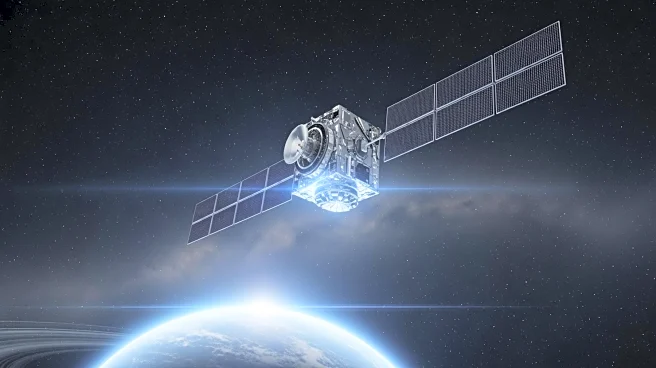
NASA has launched the Pandora satellite as part of its Astrophysics Pioneers program, which aims to conduct significant astrophysical research at a reduced cost while training future leaders in space science.
Pandora will focus on observing exoplanets and their host stars during transits, where planets pass in front of stars from Earth's perspective. This process allows scientists to analyze starlight that passes through a planet's atmosphere, revealing chemical compositions such as water and oxygen. The satellite will study at least 20 exoplanets and their stars, conducting ten 24-hour observations for each. The data collected will help determine how stellar surface features affect measurements of planetary atmospheres. Pandora's telescope, developed by Lawrence Livermore National Laboratory and Corning Specialty Materials, will capture visible and near-infrared light, utilizing a spare detector from the James Webb Space Telescope.
Why It's Important?
The Pandora mission is significant as it addresses the challenges of distinguishing between signals from planetary atmospheres and those from stellar surfaces. By providing detailed observations of exoplanets and their stars, Pandora will enhance understanding of planetary compositions and the potential for life beyond Earth. This mission also represents a cost-effective approach to astrophysical research, potentially setting a precedent for future space exploration projects. The insights gained could influence the search for habitable planets and the study of planetary systems, contributing to broader scientific knowledge and technological advancements in space exploration.
What's Next?
Pandora's mission will continue with its scheduled observations, and the data collected will be analyzed to refine models of exoplanetary atmospheres. The findings could lead to further missions under the Astrophysics Pioneers program, expanding the scope of low-cost, high-impact space research. As the mission progresses, collaboration with other space agencies and research institutions may enhance the scientific output and application of the data. The success of Pandora could inspire similar initiatives, fostering innovation and training in the field of astrophysics.