




What's Happening?
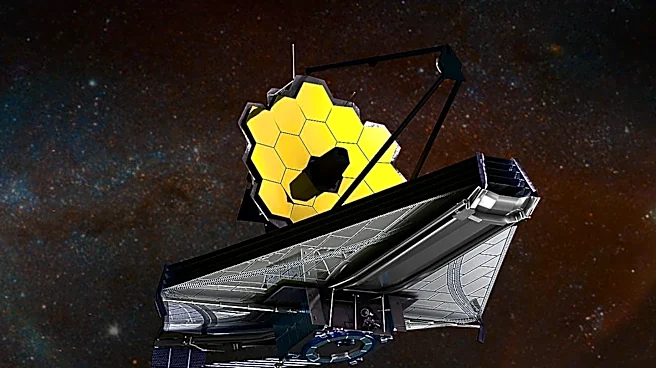
Recent data from the James Webb Space Telescope (JWST) has provided new insights into the prevalence and evolution of black holes in the early universe. The observations indicate a significant abundance of black holes that formed during this period, suggesting
a co-evolutionary relationship with their host galaxies. These black holes are characterized by their immense gravitational pull, so strong that not even light can escape once it crosses their event horizon. They are believed to form from the remnant cores of massive stars, specifically when these cores exceed approximately three solar masses. The JWST's findings highlight the transformative role these early black holes play in galactic development, influencing star formation and shaping the structure of massive galaxies through the release of vast amounts of energy in the form of radiation and powerful jets.
Why It's Important?
The discovery of numerous black holes in the early universe by the James Webb Space Telescope is crucial for understanding the fundamental processes that govern galaxy formation and evolution. This co-evolutionary model suggests that black holes are not merely passive inhabitants of galaxies but active agents in their development. The energy unleashed by these black holes, through radiation and jets, can significantly impact the surrounding galactic environment. This energy can either trigger or suppress star formation, thereby dictating the growth and morphology of massive galaxies. Understanding this intricate relationship is vital for refining cosmological models and providing a more complete picture of how the universe transitioned from its early, chaotic state to the structured cosmos we observe today. The findings challenge previous assumptions about the timeline and mechanisms of black hole growth and their influence on cosmic structures.
What's Next?
Future research will likely focus on further analyzing the extensive data collected by the James Webb Space Telescope to gain a more detailed understanding of the properties and distribution of these early universe black holes. Scientists will aim to characterize their masses, accretion rates, and the specific mechanisms through which they interact with their host galaxies. This will involve developing more sophisticated simulations and theoretical models to reconcile the observational data with existing cosmological theories. Continued observations with JWST and other advanced telescopes will be essential to track the evolution of these black holes and their galactic environments over cosmic time. The insights gained will help refine our understanding of the universe's formative years and the fundamental forces that shaped its development.
Beyond the Headlines
The implications of the JWST's findings extend beyond astrophysics, touching upon our understanding of the universe's fundamental constants and the very nature of spacetime. The existence of such numerous and influential black holes in the early universe raises profound questions about the initial conditions of the cosmos and the processes that led to the formation of the first massive structures. It underscores the dynamic and interconnected nature of cosmic phenomena, where seemingly disparate entities like black holes and galaxies are deeply intertwined in their evolutionary paths. This research also highlights the power of advanced observational technology, like the JWST, to push the boundaries of human knowledge and reveal previously unseen aspects of our universe, potentially leading to new theoretical frameworks in physics and cosmology.