








What's Happening?
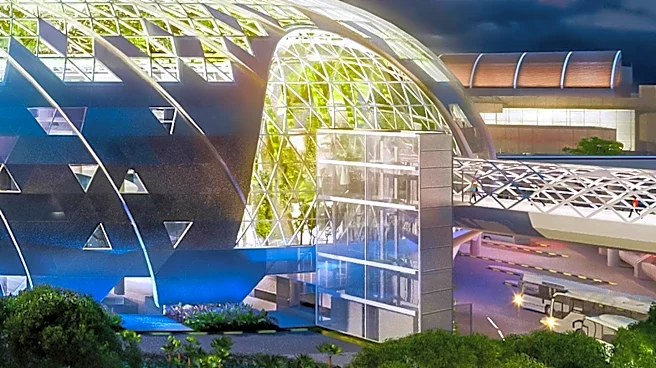
Major airports across Texas are undergoing significant expansion projects to meet future travel demand and enhance the passenger experience. At George Bush Intercontinental Airport in Houston, United Airlines has opened its new Terminal B concourse, featuring
22 gates. This new facility replaces the previous concourse, which dated back to 1969, and is part of a $2.6 billion, three-year project. United Airlines, which operates approximately 500 daily flights from Houston, aims to modernize its operations with these improvements. The expansion also includes a new United Club lounge, spanning approximately 54,000 square feet, making it the largest United Club lounge in the Americas. Andy Jamison, managing director of customer service at United Airlines, stated that these improvements are crucial for the airline's growth plan, 'United Next,' which has already seen an increase in larger aircraft and new destinations.
Why It's Important?
These extensive airport expansions in Texas are critical for the state's economic growth and its role as a major transportation hub in the U.S. The significant investment in infrastructure, such as the $2.6 billion project at George Bush Intercontinental Airport, reflects a proactive approach to managing increasing passenger volumes and modernizing air travel. Improved airport facilities can boost tourism, facilitate business travel, and enhance cargo operations, all of which contribute to regional and national economic prosperity. For airlines like United, these upgrades are essential for operational efficiency, customer satisfaction, and competitive positioning. The creation of larger, more modern concourses and lounges directly impacts the passenger experience, potentially attracting more travelers and solidifying Texas's status as a key gateway for domestic and international travel.
What's Next?
While the new Terminal B concourse at Houston's George Bush Intercontinental Airport is operational, the terminal's new lobby is anticipated to open later this year. Passengers traveling through Bush Intercontinental Airport are advised to allocate extra time due to ongoing construction and traffic. Dallas-Fort Worth International Airport is also implementing upgrades based on passenger feedback, focusing on open spaces, natural lighting, and enhanced technology access, including power outlets at every seat. United Airlines plans to expand its international service with new nonstop flights to Caracas, Venezuela, and Cartagena, Colombia, scheduled for later this year. These developments indicate a continuous effort to improve air travel infrastructure and services across Texas, with further enhancements and new routes expected in the near future.
Beyond the Headlines
The substantial investments in Texas airports reflect a broader national trend of modernizing aging infrastructure to support economic growth and global connectivity. Beyond the immediate benefits of increased capacity and improved passenger experience, these projects have long-term implications for urban development, job creation, and environmental sustainability. The focus on passenger feedback, as seen at DFW, suggests a shift towards more user-centric design in airport planning, which could influence future airport developments nationwide. Furthermore, the expansion of international routes, such as United's new flights to South America, underscores the growing importance of U.S. airports as international gateways, facilitating trade, cultural exchange, and diplomatic ties. These infrastructure projects are not just about air travel; they are about positioning U.S. cities for future global competitiveness.