




What's Happening?
New research suggests that the quantum vacuum, traditionally thought of as empty space, is a dynamic entity with energy fluctuations that can impact astrophysical phenomena. According to a study highlighted by Phys.org, these fluctuations are believed
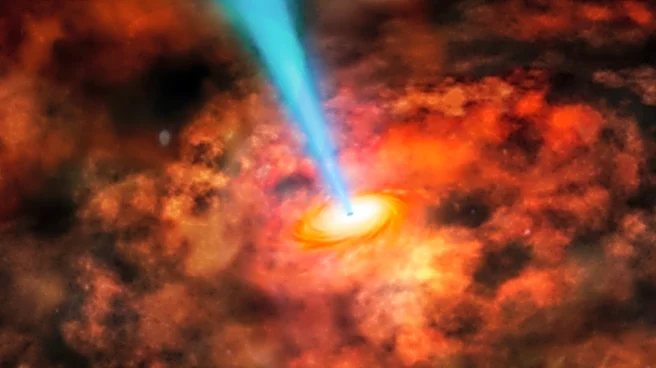
to be the only known mechanism by which black holes can shrink, causing them to 'evaporate' into surrounding space. This process occurs because the strong gravitational acceleration near a black hole, generated by space-time curvature, modifies the number and distribution of particles within the vacuum. Furthermore, modern cosmologists propose that these quantum vacuum fluctuations in the early universe 'seeded' the initial density differences in matter, which eventually led to the formation of galaxy clusters across the cosmos. The concept of a dynamic quantum vacuum has been observed in various experiments, including its effects on atoms and molecules, such as the aurora borealis, and its influence on the Lamb shift in hydrogen atoms.
Why It's Important?
This understanding of the quantum vacuum's role has profound implications for fundamental physics and cosmology. If black holes indeed shrink and 'evaporate' due to quantum vacuum effects, it provides a crucial mechanism for their long-term evolution and eventual disappearance, challenging previous notions of their permanence. For cosmology, the idea that quantum vacuum fluctuations were instrumental in forming galaxies suggests a deeper connection between quantum mechanics and the large-scale structure of the universe. This research could lead to a more unified theory of physics, bridging the gap between quantum mechanics and general relativity. The ability to observe and understand these microscopic effects also has practical applications, such as in quantum computing and quantum simulators, where precise control over quantum systems is essential. The ongoing efforts to directly observe quantum vacuum fluctuations using high-intensity laser beams underscore the scientific community's commitment to validating these theoretical predictions.
What's Next?
Future research will likely focus on further experimental verification of quantum vacuum fluctuations and their predicted effects. Scientists are working on experiments, such as those using high-intensity laser beams, to directly observe these fluctuations and their impact on particles. These experiments aim to test the predictions of quantum mechanics regarding the vacuum's structure. Additionally, cosmologists will continue to explore how these quantum effects influenced the early universe and the formation of cosmic structures, potentially refining models of galaxy formation. The insights gained from studying the quantum vacuum near extreme astrophysical objects like black holes could also lead to new theoretical frameworks for understanding gravity and quantum mechanics in extreme environments. The development of quantum technologies, such as quantum computers and simulators, will also benefit from a deeper understanding of these fundamental quantum phenomena.
Beyond the Headlines
The concept of a dynamic quantum vacuum challenges our intuitive understanding of 'empty space,' revealing it as a bustling arena of fluctuating energy and particles. This shift in perspective has philosophical implications, suggesting that even the void is teeming with activity that shapes the universe. The ability of black holes to 'evaporate' due to quantum effects introduces a mechanism for information to potentially escape from behind the event horizon, a long-standing paradox in theoretical physics. This could lead to a re-evaluation of the information paradox and the nature of black holes themselves. Furthermore, the idea that the universe's large-scale structure originated from microscopic quantum fluctuations highlights the interconnectedness of phenomena across vast scales, from the subatomic to the cosmic. This research underscores the ongoing quest to reconcile quantum mechanics with general relativity, two pillars of modern physics that describe the universe at its smallest and largest scales, respectively.