
What's Happening?
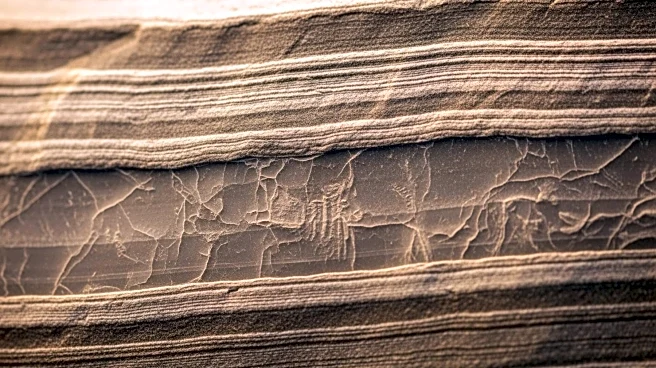
A recent study has provided new insights into the fossilization process of soft-bodied organisms from the Precambrian era, specifically the Ediacaran period. These fossils, found in Newfoundland, are preserved
in sandstone, revealing details about ancient life forms that existed over 541 million years ago. The study, led by Dr. Lidya Tarhan from Yale University, explains that the preservation was due to a natural cement formed by sand grains and clay precipitated from iron and silicate-rich seawater. This discovery challenges previous assumptions that only tough organisms could be fossilized, highlighting the role of environmental conditions in fossil preservation.
Why It's Important?
Understanding the fossilization process of soft-bodied organisms is crucial for paleontologists as it provides a more accurate picture of early life on Earth. The findings from this study could lead to a reevaluation of the fossil record, offering new insights into the evolution of complex life forms. This research not only enhances our knowledge of the Ediacaran biota but also informs the methods used to study other exceptionally preserved fossil assemblages. The implications extend to evolutionary biology, helping scientists trace the origins and development of modern animal phyla.
What's Next?
The study opens avenues for further research into the environmental conditions that favor fossilization, potentially leading to new discoveries of ancient life forms. Paleontologists may focus on identifying other sites with similar preservation conditions, expanding the known diversity of Precambrian organisms. Additionally, the findings could influence the search for extraterrestrial life by providing a model for how life might be preserved on other planets with similar geological conditions.