
What's Happening?
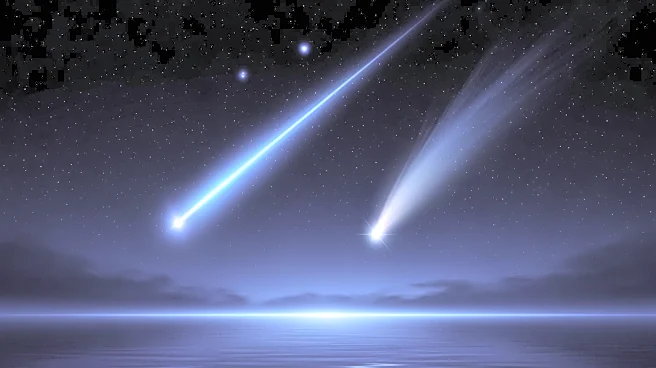
The Geminid meteor shower, one of the most anticipated astronomical events of the year, is currently active and expected to peak on December 14. This annual meteor shower is known for its high meteor count,
often producing up to 120 meteors per hour. Concurrently, Comet 24P/Schaumasse is making its way through the sky, providing an additional spectacle for sky watchers. The comet is currently positioned near the constellation Leo, specifically 8.8 degrees west-northwest of the star Denebola, and is visible at around 3 A.M. local time. The waning crescent Moon, at 37% illumination, is present but not significantly hindering visibility. Observers are encouraged to look for the comet near the galaxies NGC 3607 and NGC 3608, which are slightly brighter and can serve as reference points.
Why It's Important?
The Geminid meteor shower and the visibility of Comet Schaumasse offer a unique opportunity for both amateur and professional astronomers to observe celestial phenomena. The Geminids are particularly significant due to their high frequency and brightness, making them one of the most reliable meteor showers. This event not only captivates the public's interest in astronomy but also provides valuable data for scientists studying meteoroid streams and their interactions with Earth's atmosphere. The presence of Comet Schaumasse adds to the excitement, as comets are less frequently visible and offer insights into the early solar system's composition and dynamics. These events can inspire educational outreach and increase public engagement with science.
What's Next?
As the peak of the Geminid meteor shower approaches, observers are advised to find locations with minimal light pollution to maximize their viewing experience. The best time to observe the meteors is after midnight, when the radiant point in the constellation Gemini is highest in the sky. For those interested in Comet Schaumasse, continued observation is recommended in the early morning hours, as the Moon's later rising time will improve visibility. Astronomers and enthusiasts alike will likely continue to monitor these events, capturing images and data that contribute to our understanding of these celestial phenomena.