








What's Happening?
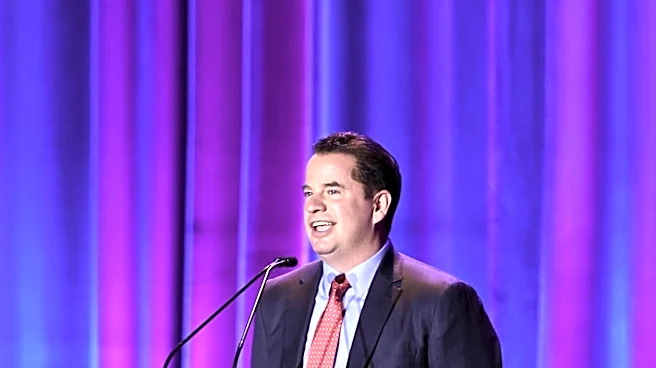
Ben Shapiro, a prominent pro-Israel blogger and co-founder of The Daily Wire, has released a new film titled 'Run Hide Fight: Infidels.' Shapiro claims Hollywood has avoided depicting 'the threat of radical Islam' for three decades, and describes his
film as the 'biggest, most audacious, funniest and most kickass' production by The Daily Wire. However, the film is drawing criticism for allegedly recycling decades-old anti-Muslim tropes. The trailer for 'Run Hide Fight: Infidels' reportedly centers on a college campus overtaken by 'radical Islamic terrorists' who establish a 'makeshift caliphate,' impose 'Sharia law,' and execute 'infidels.' The film also reportedly juxtaposes imagery from ISIS and 9/11 with footage of 2024 college campus protests, linking a real political movement—students protesting Israel's actions in Gaza—with extremist violence. Critics argue that this portrayal is not new, as Hollywood has historically depicted Muslims as terrorists and extremists, a trend documented by American writer and educator Jack Shaheen in his book 'Reel Bad Arabs.'
Why It's Important?
The release of 'Run Hide Fight: Infidels' is significant because it contributes to and potentially exacerbates existing anti-Muslim sentiment in the U.S. and globally. By linking contemporary campus protests with radical Islamic terrorism, the film could fuel Islamophobia and prejudice against Muslim communities and those advocating for Palestinian rights. This narrative risks normalizing the perception of Muslims as a security threat, which has historically led to real-world consequences, including increased hate crimes and discrimination. The film's timing, amidst heightened anti-Muslim hate and an election season where voters are increasingly scrutinizing candidates' stances on the Israeli-Palestinian conflict, amplifies its potential impact. It could further polarize public discourse and influence political narratives, particularly concerning free speech on college campuses and the portrayal of minority groups in media. The film's promotion by a figure like Ben Shapiro, who has a significant platform, ensures its reach and potential to shape public opinion.
What's Next?
The film's release is likely to continue generating debate and controversy, particularly within civil liberties and advocacy organizations. Groups like the Council on American-Islamic Relations (CAIR-LA) may intensify their efforts to counter what they perceive as Islamophobic narratives. There could be calls for boycotts or protests against the film and its distributors. The discussion around the film may also prompt further examination of media representation of Muslim and Arab communities, potentially leading to increased advocacy for more nuanced and accurate portrayals. Additionally, the film's approach to linking campus activism with terrorism could influence how universities and law enforcement respond to future protests, potentially leading to stricter measures or increased surveillance of student groups. The ongoing political climate, especially with upcoming elections, suggests that the themes explored in the film could become talking points for political figures, further entrenching divisions.
Beyond the Headlines
Beyond the immediate controversy, 'Run Hide Fight: Infidels' touches upon deeper implications regarding media's role in shaping public perception and the weaponization of stereotypes. The film's narrative, which critics argue repackages old tropes, highlights a persistent challenge in media representation where certain groups are consistently cast in negative or threatening roles. This perpetuates a cycle of misunderstanding and prejudice, making it difficult for audiences to see these communities in a complex and humanized light. The film also raises questions about the responsibility of media creators and platforms in an era of heightened political and social tensions. The juxtaposition of real-world protests with fictionalized extremist violence blurs the lines between legitimate activism and terrorism, potentially chilling free speech and dissent. This approach can have long-term societal effects, fostering an environment where fear and suspicion override critical thinking and empathy, ultimately undermining social cohesion and democratic values.