
What's Happening?
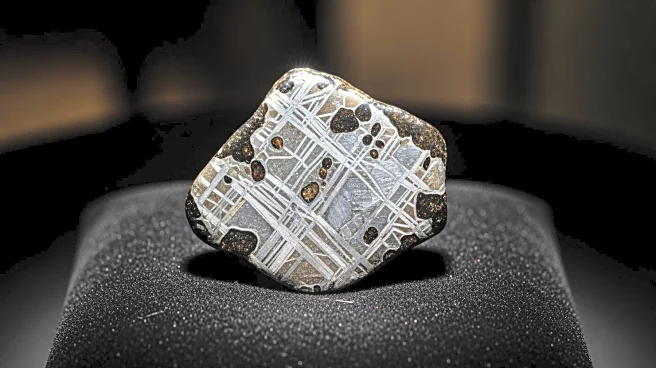
A significant auction event took place at Sotheby’s in July, where a 54-pound Martian meteorite, known as NWA 16788, was sold for a record $5.3 million. The meteorite, discovered in Niger's Sahara Desert
in 2023, is a rare fragment of the Martian crust, believed to have been ejected from Mars about five million years ago due to an asteroid impact. The auction attracted global interest from institutions, private collectors, and natural history enthusiasts, all vying for this unique piece of extraterrestrial history. Despite its sale to an anonymous bidder, a portion of the meteorite has been preserved and analyzed at China’s Purple Mountain Observatory, ensuring that scientific research can continue.
Why It's Important?
The sale of NWA 16788 highlights the growing interest and market for extraterrestrial artifacts, particularly those from Mars, which are exceedingly rare. With fewer than 500 confirmed Martian meteorites, the auction underscores the value placed on such specimens by collectors and institutions. The transaction also raises questions about the ownership and accessibility of significant scientific materials, as some scientists express concern over the privatization of such rare finds. However, the preservation of a sample for research purposes mitigates some of these concerns, allowing continued scientific exploration and study of Martian geology.
What's Next?
The sale of NWA 16788 may inspire further interest and investment in the collection and auction of meteorites, potentially leading to more discoveries and sales in the future. Institutions and collectors might increase efforts to acquire similar specimens, driving up demand and prices. Additionally, the scientific community may advocate for policies ensuring that significant extraterrestrial finds remain accessible for research, balancing private ownership with public scientific interest.
Beyond the Headlines
The auction of NWA 16788 reflects broader cultural and scientific fascinations with Mars and space exploration. As humanity continues to explore the possibility of Mars colonization and the search for extraterrestrial life, such meteorites serve as tangible connections to these distant worlds. The event also highlights the ethical considerations of privatizing space artifacts, prompting discussions about the stewardship of space resources and the role of private collectors in preserving scientific heritage.