



What's Happening?
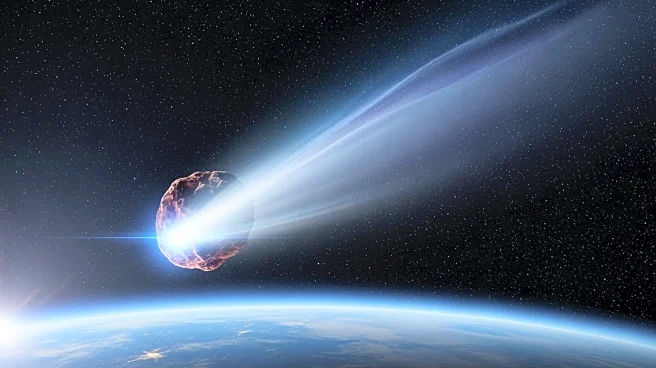
Comet 3I/ATLAS, an interstellar object, recently made its closest approach to Earth, passing within approximately 168 million miles. This distance, while vast, is relatively short in astronomical terms, yet the comet remained invisible to the naked eye,
requiring telescopes for observation. Discovered in July, the comet is notable for being only the third interstellar visitor detected, and it is believed to be one of the oldest comets observed. The comet's trajectory has been closely monitored by astronomers, and it will remain visible with telescopes until spring. The Virtual Telescope Project in Italy is hosting a livestream to provide real-time images of the comet as it moves towards Jupiter. The comet's origins have sparked speculation, but it is widely accepted as a natural interstellar object.
Why It's Important?
The passage of comet 3I/ATLAS is significant as it provides a rare opportunity to study an interstellar object, offering insights into the composition and behavior of comets from outside our solar system. This event allows scientists to gather data that could enhance understanding of the early solar system and the processes that govern comet formation. The comet's journey through the solar system also presents a chance for spacecraft stationed near Jupiter to observe it closely, potentially yielding valuable scientific information. The study of such interstellar objects can contribute to broader astronomical knowledge and may inform future space exploration missions.
What's Next?
Comet 3I/ATLAS is set to pass close to Jupiter on March 15, 2026, coming within 33 million miles of the planet. This proximity may allow spacecraft like Juno to capture detailed observations. Following its encounter with Jupiter, the comet will continue its journey, crossing the orbits of Saturn, Uranus, and Neptune over the next few years. Researchers will continue to monitor the comet to learn more about its properties, such as its size and origin, although determining its exact star system of origin may remain elusive. The ongoing study of 3I/ATLAS will likely contribute to the understanding of interstellar objects and their trajectories.