



What's Happening?
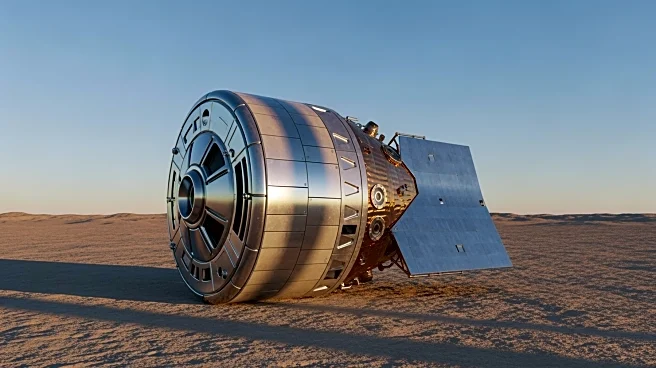
The Soyuz MS-27 spacecraft, carrying NASA astronaut Jonny Kim and Roscosmos cosmonauts Sergey Ryzhikov and Alexey Zubritsky, successfully landed on the steppe of Kazakhstan at 12:03 a.m. EST. This marked the end of their 245-day mission aboard the International
Space Station (ISS), during which they orbited Earth 3,920 times and traveled nearly 104 million miles. The mission, which began with the spacecraft's launch and docking on April 8, was the first spaceflight for both Kim and Zubritsky. Ryzhikov, however, added to his extensive space experience, now totaling 603 days across three missions. Following their landing, the crew will be transported by helicopter to Karaganda, Kazakhstan, where recovery teams are stationed. Kim will then return to Houston via a NASA aircraft, while Ryzhikov and Zubritsky will head to their training base in Star City, Russia.
Why It's Important?
This mission underscores the ongoing international collaboration in space exploration, particularly between NASA and Roscosmos. The successful completion of the mission contributes valuable data and insights into long-duration space travel, which is crucial for future missions, including those planned under NASA's Artemis program aimed at returning humans to the Moon. The experience gained by astronauts like Jonny Kim is vital for the development of future space missions and the training of new astronauts. Additionally, the mission's success highlights the reliability and effectiveness of the Soyuz spacecraft, which remains a critical component of human spaceflight operations.
What's Next?
The crew's return marks the continuation of the ISS's role in facilitating international space research and collaboration. As NASA and its partners prepare for future missions, including potential manned missions to Mars, the data and experiences from this mission will inform planning and training. The astronauts will undergo post-mission debriefings and health assessments to evaluate the effects of long-duration spaceflight on the human body, which will be crucial for future mission planning. The ISS will continue to host international crews, with upcoming missions already scheduled to further scientific research and technological development in space.