
What's Happening?
Chile's Atacama Desert, recognized as the driest non-polar place on Earth, is a region of extraordinary geological diversity and rich Indigenous culture. The landscape features the 1,200-square-mile Atacama Salt
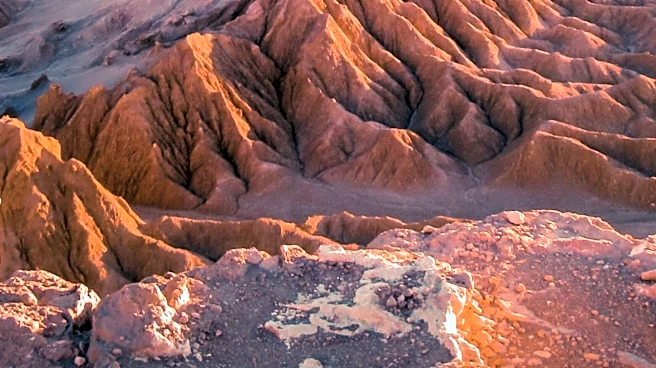
Flat, where pink flamingos thrive in turquoise lagoons, sustained by melting snow from the Andes and underground springs. Other notable sites include Rainbow Valley, with its vivid multicolored hills formed by volcanic eruptions and mineral deposits, and the El Tatio geysers, one of the highest geothermal fields globally, where over 80 geysers steam into the sky at 14,170 feet altitude. The region also hosts ancient archaeological sites like Tulor Village, buried under shifting dunes, and is used by NASA for testing robotic rovers due to its Mars-like terrain. Indigenous Atacameño people celebrate Pachamama Day annually, honoring Mother Earth with rituals and offerings, revering the Licancabur Volcano as a living deity.
Why It's Important?
The Atacama Desert's unique environment offers significant insights into extreme ecosystems and geological processes, making it a valuable site for scientific research, including astrobiology and planetary exploration, as evidenced by NASA's activities. Its distinct geological formations and high-altitude observatories contribute to global understanding of astronomy and Earth sciences. The preservation of Indigenous traditions, such as Pachamama Day, highlights the cultural heritage and deep connection between the Atacameño people and their environment, offering a perspective on sustainable living and spiritual reverence for nature. For the U.S., this region provides a natural laboratory for space exploration technologies and climate studies, while also showcasing the importance of cultural preservation in the face of environmental challenges. The tourism potential also contributes to the local economy, attracting international visitors interested in unique natural and cultural experiences.
What's Next?
Continued scientific research in the Atacama Desert is expected, particularly in fields related to astrobiology and climate change, given its extreme conditions and geological features. Efforts to preserve the Indigenous cultural practices and archaeological sites will likely continue, potentially involving collaborations between local communities, national authorities, and international organizations. The growing interest in astrotourism and eco-tourism may lead to further development of sustainable tourism infrastructure, balancing economic benefits with environmental protection. The impact of climate change on the Andean snowmelt, a crucial water source for the desert's oases and wildlife, will be a critical area of monitoring and concern, influencing the long-term viability of both the natural ecosystems and human settlements in the region.
Beyond the Headlines
The Atacama Desert serves as a powerful symbol of resilience and adaptation, both for its natural ecosystems and its Indigenous inhabitants. The stark beauty and extreme conditions challenge conventional notions of life and habitability, prompting deeper questions about planetary evolution and the potential for life beyond Earth. The reverence of the Atacameño people for their land, embodied in traditions like Pachamama Day and the myths surrounding Licancabur Volcano, offers a profound counter-narrative to purely extractive views of natural resources. This cultural dimension underscores the ethical considerations in scientific exploration and tourism, emphasizing the need for respect for local heritage and environmental stewardship. The desert's role as a testing ground for Mars rovers also blurs the lines between terrestrial and extraterrestrial exploration, highlighting humanity's continuous quest for understanding our place in the universe.