


What's Happening?
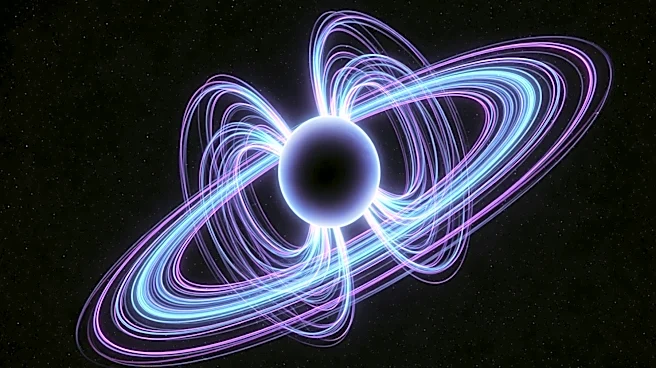
Recent research involving scientists from University College London has revealed that Saturn's magnetic field is uneven, unlike Earth's symmetrical magnetic bubble. This distortion is attributed to the planet's rapid rotation and the substantial amount
of material it drags through space. The findings, published in Nature Communications, are based on six years of observations from NASA's Cassini mission. Researchers identified the exact position of Saturn's magnetic cusp, a region where magnetic field lines bend back toward the poles, allowing charged particles to funnel into the atmosphere. The cusp is consistently shifted to one side, appearing displaced to the right when viewed from the Sun. This offset is linked to Saturn's fast rotation and the dense plasma environment surrounding it, primarily from gases released by its moons, especially Enceladus.
Why It's Important?
Understanding Saturn's magnetic field is crucial for future space exploration, particularly as plans for missions to Saturn and its moon Enceladus are developed. The study provides evidence for the theory that the rapid spin of massive planets with active moons replaces the solar wind as the dominant force shaping magnetospheres. This knowledge is vital for mapping Saturn's magnetic environment and could inform the exploration of other gas giants. The findings also highlight the role of Enceladus in releasing water vapor that loads the magnetosphere with heavy plasma, influencing the planet's magnetic field.
What's Next?
The research feeds into the excitement of returning to Saturn, with future missions aiming to explore habitability and potential signs of life on Enceladus. Further simulations are needed to confirm the explanation of the magnetic field's distortion. The study's insights into planetary magnetic fields could also aid in understanding the magnetospheres of other rapidly spinning gas giants, potentially impacting the planning and execution of future space missions.