







What's Happening?
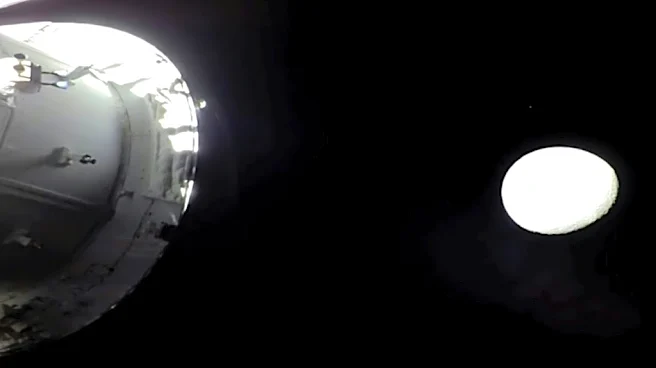
NASA's Artemis II mission has successfully completed a record-breaking lunar flyby, marking the first crewed mission to the Moon since 1972. The mission, which took place on April 6 and 7, 2026, involved the Orion spacecraft traveling to a distance of
252,756 miles from Earth, surpassing the previous record set by Apollo 13. During the mission, the crew had the opportunity to view the Moon's far side and witness a total solar eclipse from deep space, a phenomenon never before seen by humans. The mission's 10-day journey began on April 1, 2026, with the spacecraft entering the Moon's gravitational pull on the sixth day. The flyby allowed the crew to collect valuable scientific data from the Moon's far side, enhancing our understanding of its geological features.
Why It's Important?
The Artemis II mission represents a significant advancement in human space exploration, demonstrating NASA's ability to conduct complex missions beyond Earth's orbit. The successful flyby not only sets a new record for human space travel but also provides critical data that will inform future lunar exploration efforts. The mission's achievements highlight the potential for further exploration of the Moon and beyond, contributing to scientific knowledge and technological innovation. The ability to observe a total solar eclipse from deep space offers unique insights into the Sun's outer atmosphere, which could have implications for understanding solar phenomena and their effects on space weather.
What's Next?
Following the successful completion of the lunar flyby, the Orion spacecraft is on its way back to Earth, with a planned splashdown in the Pacific Ocean on April 10, 2026. The mission's success is expected to bolster support for NASA's Artemis program, which aims to establish a sustainable human presence on the Moon. Future missions may focus on landing astronauts on the lunar surface and conducting more detailed scientific research. The Artemis program's progress will be closely watched by international space agencies and private companies, potentially leading to increased collaboration in space exploration.