





What's Happening?
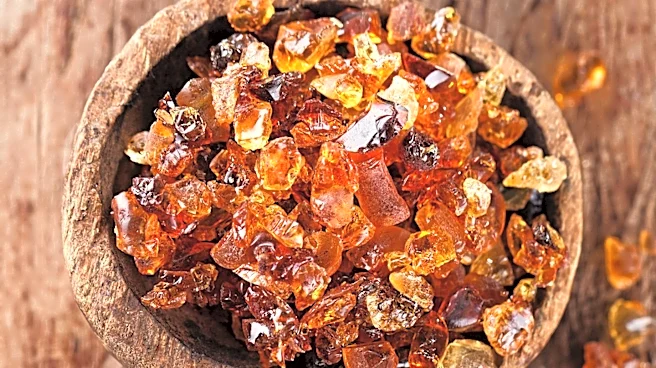
Paleontologists have uncovered the world's oldest amber in a coal bed in China's far northwest, dating back to the Middle Devonian period, approximately 385 million years ago. This discovery predates the previous oldest amber record by 65 million years and
occurs 150 million years before the first dinosaurs. The amber fragments, found in the Hujiersite Formation, range from 0.1 to 1.5 millimeters in size and were identified using ultraviolet light. The study, led by Cihang Luo from the Chinese Academy of Sciences, suggests that the amber was produced by non-seed vascular plants, indicating that sophisticated resin biosynthesis appeared much earlier than previously thought. This finding provides new insights into the evolution of early plants and their ability to produce resin, which may have been a crucial adaptation for survival in terrestrial environments.
Why It's Important?
The discovery of such ancient amber is significant as it challenges previous understandings of plant evolution, particularly the development of resin production. This adaptation likely played a vital role in the survival and expansion of early vascular plants across terrestrial landscapes. The ability to produce resin could have provided plants with a defense mechanism against environmental threats such as wildfires and parasitic fungi, even before the emergence of major plant grazers like insects. This finding not only extends the timeline of resin production but also highlights the complexity of early plant ecosystems and their evolutionary innovations.
What's Next?
Future research may focus on identifying even older amber deposits, as molecular studies suggest that plants had the genetic capability to produce resin compounds much earlier than the Middle Devonian. Researchers may explore Early Devonian organic-rich coals and sediments to uncover more ancient amber records. Such discoveries could further illuminate the evolutionary history of plants and their adaptations to changing environments.