







What's Happening?
National Hispanic Heritage Month has begun, running from September 15 to October 15, with celebrations taking place across the United States. This annual observance is dedicated to recognizing and honoring the diverse cultures and significant contributions
of Hispanic people in the U.S. The month-long event provides an opportunity for Americans to learn about the rich heritage of individuals whose ancestors hail from Spain, Mexico, the Caribbean, and Central and South America. The observance originated as Hispanic Heritage Week, established by President Lyndon B. Johnson in 1968 through legislation introduced by Mexican American U.S. Rep. Edward R. Roybal. It was later expanded to a full month under President Ronald Reagan. September 15 was chosen to coincide with the independence day anniversaries of several Latin American nations, including Costa Rica, El Salvador, Guatemala, Honduras, and Nicaragua.
Why It's Important?
National Hispanic Heritage Month holds significant cultural and social importance in the U.S. as it acknowledges the nation's largest racial or ethnic minority group, comprising over 70 million ethnically Hispanic residents who make up one-fifth of the total U.S. population. This celebration fosters greater understanding and appreciation of the diverse traditions, histories, and achievements of Hispanic communities, which are deeply interwoven into the fabric of American society. It serves as a platform to educate the broader public about the historical struggles and triumphs of these communities, including their strong ties to the labor movement, as highlighted by Paul Ortiz, a professor of Latina/o labor history at Cornell University. The month also encourages reflection on the complexities of identity within the Hispanic/Latino community, including the nuances of terms like 'Hispanic,' 'Latino,' and 'Latinx,' and the distinct cultural identities within the diaspora.
What's Next?
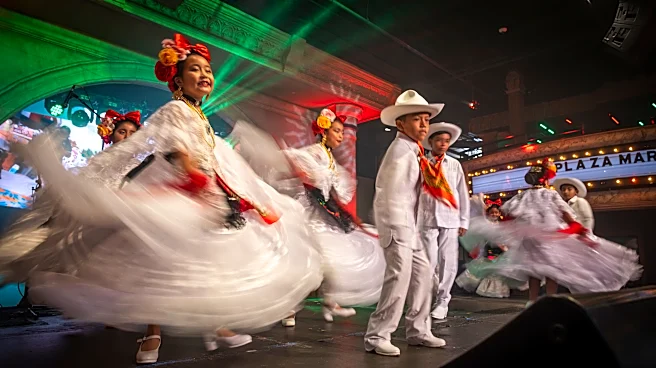
Throughout National Hispanic Heritage Month, various cultural events, educational programs, and community gatherings will take place across the U.S. These activities are expected to further promote cultural exchange and dialogue, enhancing public awareness of Hispanic heritage. Educational institutions, community organizations, and government entities will likely host events showcasing Hispanic art, music, cuisine, and historical narratives. The observance may also spark continued discussions about representation, diversity, and inclusion in various sectors of American society. As the U.S. Latino consumer base continues to grow, there may be increased commercial engagement and marketing efforts tailored to Hispanic communities, further integrating their cultural influence into mainstream American life.
Beyond the Headlines
Beyond the immediate celebrations, National Hispanic Heritage Month underscores deeper themes of identity, historical memory, and social justice. It prompts a critical examination of how different cultures contribute to the national identity and challenges monolithic perceptions of American culture. The month also serves as a reminder of the ongoing struggles faced by Hispanic communities, including issues related to immigration, economic equity, and political representation. The historical context of colonialism in Latin America and its lasting impact on these communities is often a subtext of the observance, encouraging a more nuanced understanding of their experiences. Furthermore, the month highlights the evolving linguistic and cultural landscape of the U.S., emphasizing the importance of bilingualism and multiculturalism in a diverse society.