
What's Happening?
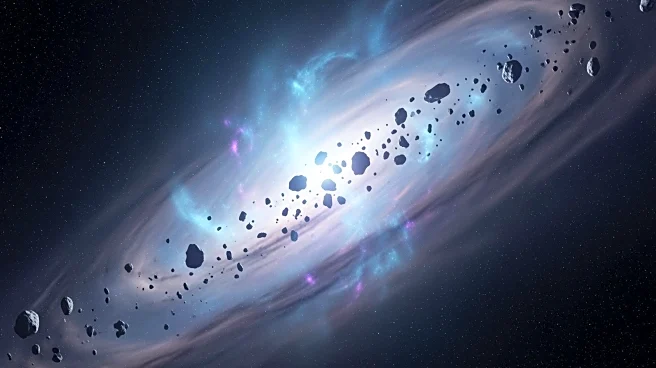
NASA's Hubble Space Telescope has provided a rare glimpse into the aftermath of two cosmic collisions, helping scientists resolve a mystery that has persisted for decades. Initially, a bright spot near
the young star Fomalhaut was thought to be a planet. However, Hubble's observations in 2023 revealed that the spot had vanished, replaced by another, indicating it was not a planet but rather the result of massive space rocks colliding. These collisions created dust clouds dense enough to mimic planets, which eventually dispersed. The space rocks involved were estimated to be at least 37 miles wide. Such collisions are rare, occurring in the same area approximately once every 100,000 years. The findings, published in the journal Science, suggest that these events might be more common than previously thought.
Why It's Important?
The discovery is significant as it provides insights into the processes that shape planetary systems. Understanding cosmic collisions is crucial for comprehending how planets form and evolve. These events contribute to the distribution of materials that make up planets, including Earth. The study of such collisions offers a 'toddler picture' of our solar system, shedding light on its early development. The findings could lead to a reevaluation of the frequency of such collisions, potentially altering our understanding of planetary formation and the dynamics of young star systems.
What's Next?
Researchers plan to continue monitoring the new dust cloud to observe its changes and eventual disintegration. This ongoing observation will help scientists gather more data on the frequency and impact of cosmic collisions. The star near the collision site, located 25 light-years from Earth, will remain a focal point for future studies, allowing scientists to capture these violent events in real-time and further our understanding of planetary system evolution.