





What's Happening?
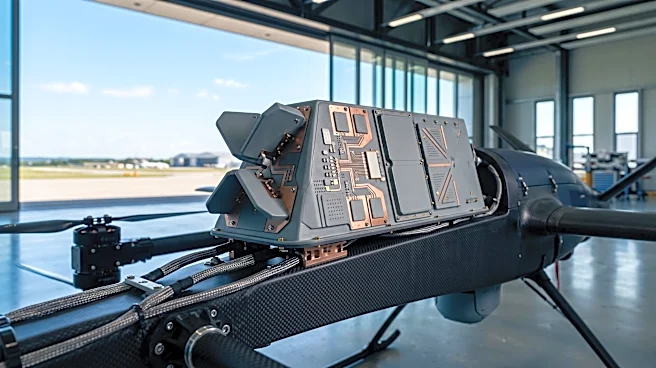
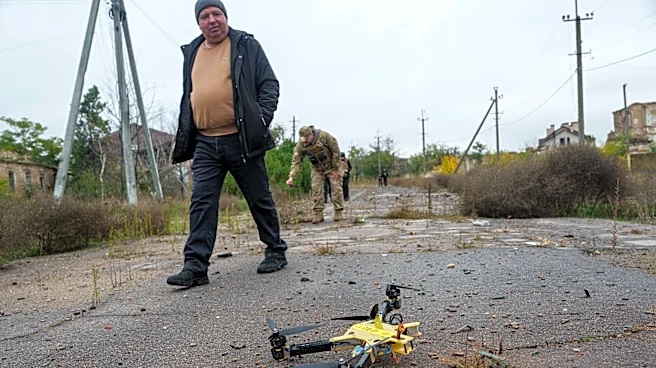
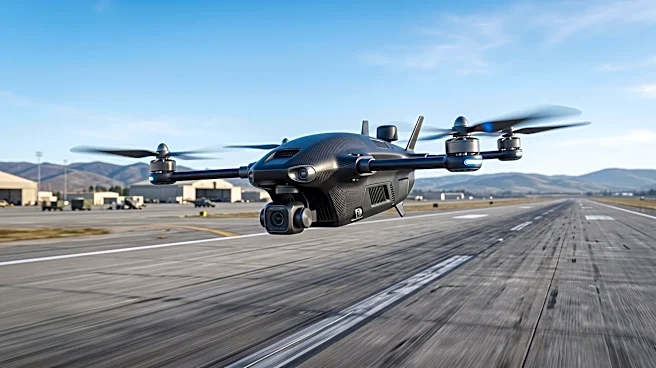
Russia is enhancing its attack drones with larger anti-jamming antennas to counteract Ukraine's electronic warfare systems, making it more challenging for Ukraine to disrupt incoming Russian strikes. These upgrades aim to protect satellite-navigation
signals, allowing drones to maintain their programmed flight paths even in areas with Ukrainian jamming. According to a report by Defense News, Russia is equipping its drones with upgraded Kometa satellite-navigation modules developed by VNIIR-Progress. These modules use multiple antenna elements to identify and suppress electronic interference, ensuring drones can navigate despite attempts to disrupt their satellite signals. Russia is already deploying 16-element antenna arrays and is preparing 20-element versions for serial production. Ukrainian forces have also observed Shahed-type drones with larger 32-element arrays during attacks on Kyiv.
Why It's Important?
This development signifies a continuous escalation in the electronic warfare aspect of the conflict, with direct implications for military technology and defense strategies globally, including for the U.S. The ability of drones to operate effectively despite GPS jamming challenges the efficacy of current electronic warfare countermeasures and necessitates the development of more sophisticated anti-jamming technologies. For the U.S. and its allies, this highlights the importance of investing in resilient navigation systems and advanced electronic warfare capabilities to maintain a technological edge. The increased effectiveness of Russian drones could alter battlefield dynamics, potentially leading to more successful strikes and posing a greater threat to Ukrainian forces and infrastructure. This technological arms race in drone warfare and electronic countermeasures will likely influence future defense procurement and research priorities for major military powers.
What's Next?
Ukrainian specialists are exploring multi-band jamming to disrupt signals across different satellite-navigation frequencies and GPS spoofing to mislead drone navigation systems. This indicates a continuous cycle of innovation in electronic warfare, where each side develops new methods to counter the other's advancements. The U.S. and its allies will likely closely monitor these developments to inform their own defense strategies and support Ukraine with advanced electronic warfare capabilities. Further research and development into anti-jamming technologies, alternative navigation methods, and drone defense systems will be critical. The ongoing conflict serves as a real-world laboratory for testing and refining these technologies, influencing the future of military operations and defense spending.
Beyond the Headlines
The technological advancements in drone anti-jamming capabilities underscore a broader trend in modern warfare: the increasing reliance on autonomous and semi-autonomous systems in contested environments. This raises ethical questions about the autonomy of weapons systems and the potential for unintended consequences when human oversight is reduced. The sophistication of these electronic warfare measures also highlights the vulnerability of satellite-based systems, not just in military contexts but also for civilian applications. This could accelerate the development of non-GPS navigation alternatives, such as celestial navigation, inertial navigation, or vision-based navigation, for both military and commercial uses. The long-term impact could be a fundamental shift in how nations approach navigation and communication security, emphasizing redundancy and resilience across all critical infrastructure.