
What's Happening?
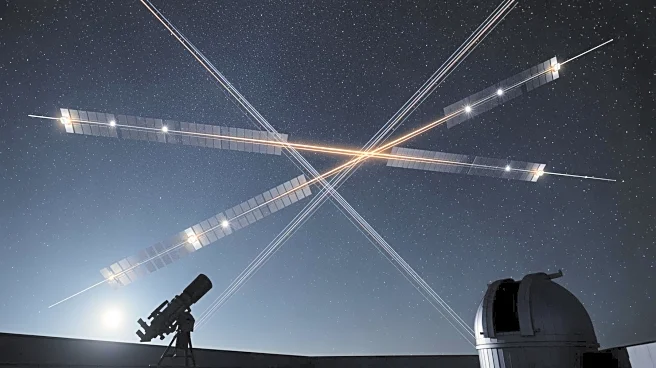
NASA has released a report indicating that the increasing number of satellite constellations in low Earth orbit (LEO) could severely impact astronomical observations. The report, published in Nature, predicts
that up to 96% of images from space telescopes could be contaminated by satellite streaks. This issue arises as companies like SpaceX, Amazon, and others plan to launch a total of 560,000 satellites, a significant increase from the current 20,000 tracked objects. The cost reduction in launching satellites, primarily due to SpaceX's Falcon 9 rocket, has accelerated this trend. Ground-based observatories, such as the Vera C. Rubin Observatory, are also at risk, with potential contamination of up to 80% of their images. The report suggests solutions like using Vantablack paint on satellites, but acknowledges that these measures alone may not suffice.
Why It's Important?
The proliferation of satellite constellations poses a significant threat to astronomical research, potentially rendering many telescopes ineffective. This could hinder scientific discoveries and our understanding of the universe. The contamination of images affects both space-based and ground-based observatories, jeopardizing projects that rely on clear, unobstructed views of the sky. The situation underscores the need for regulatory measures and technological solutions to mitigate the impact of satellite interference. The scientific community and space agencies may need to advocate for policies that balance commercial satellite deployment with the preservation of astronomical research capabilities.
What's Next?
As the number of satellites in orbit continues to grow, there may be increased public and scientific pressure on governments and companies to address the issue. Potential solutions could involve stricter regulations on satellite launches and the development of new technologies to minimize their impact on astronomical observations. Collaboration between space agencies, commercial entities, and international bodies may be necessary to implement effective strategies. The future of astronomical research could depend on the ability to adapt to these challenges and find innovative ways to protect the integrity of space observations.