




What's Happening?
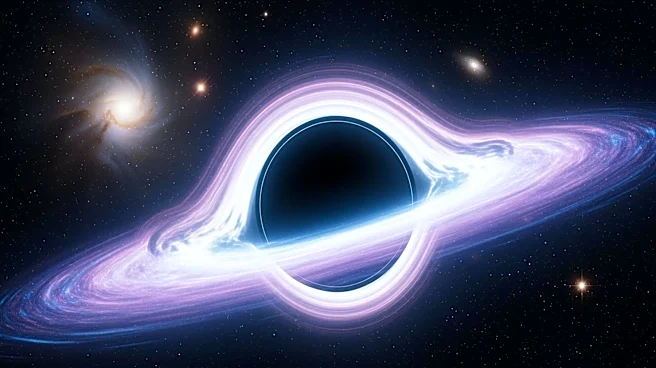
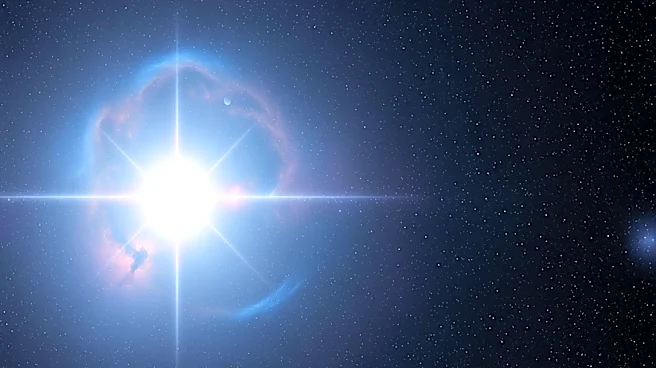
Researchers have successfully measured the energy output of the black hole Cygnus X-1's 'dancing jets' for the first time. Located approximately 7,000 light-years from Earth in the constellation Cygnus, Cygnus X-1 is a stellar-mass black hole about 21
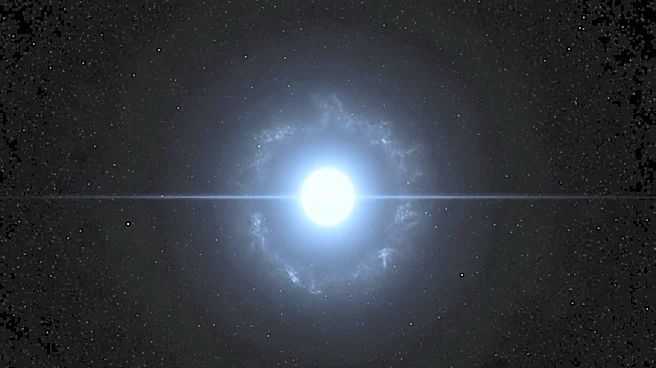
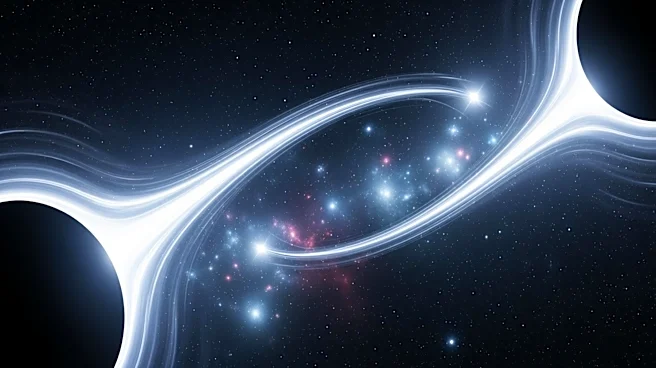
times more massive than the sun. It is in a binary orbit with a blue supergiant star, HDE 226868, from which it draws material to form an accretion disk. This disk emits powerful jets of plasma, which are influenced by the black hole's magnetic field and the stellar winds from its companion star, causing them to wobble. The jets have been measured to emit energy equivalent to 10,000 suns and travel at half the speed of light. This discovery, published in Nature Astronomy, provides new insights into the extreme behavior of black holes.
Why It's Important?
The measurement of Cygnus X-1's jets is significant as it helps fill gaps in the understanding of black hole physics. The jets carry away about 10% of the energy released as matter falls into the black hole, a key assumption in large-scale universe models. Understanding these jets can also shed light on how black holes influence their surroundings, including galaxy formation and evolution. This research could anchor the understanding of similar jets from other black holes, whether they are stellar-mass or supermassive, thus enhancing the comprehension of cosmic phenomena.
What's Next?
Researchers plan to apply the techniques used in this study to other black holes to measure jet power in more systems. This could lead to a broader understanding of black hole behavior and their role in the universe. The findings may also influence future studies on galaxy evolution and the feedback mechanisms of black holes on their environments.