
What's Happening?
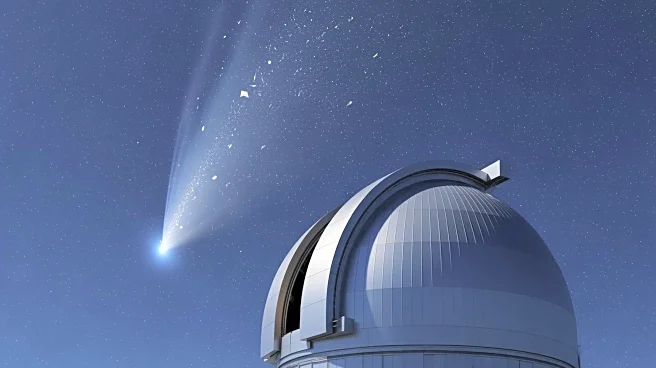
NASA's ATLAS program has identified a rare interstellar comet, 3I/ATLAS, which is set to make its closest approach to Earth on December 19, 2025. This comet is only the third confirmed interstellar object
to pass through our solar system, following 1I/‘Oumuamua and 2I/Borisov. Despite its closest approach, the comet will remain approximately 170 million miles away, posing no threat to Earth. The comet's hyperbolic orbit indicates it is not gravitationally bound to the Sun, confirming its interstellar origin. Observers are encouraged to view the comet during pre-dawn hours, with the best visibility near the constellation Leo. The Virtual Telescope Project will also provide a live broadcast of the event.
Why It's Important?
The observation of 3I/ATLAS offers a unique scientific opportunity to study material from outside our solar system. Interstellar comets like 3I/ATLAS can provide insights into the composition of other planetary systems, potentially revealing differences from solar system comets. This event allows scientists to gather data on the comet's composition and behavior, contributing to our understanding of the universe. The comet's approach is a rare chance for coordinated study using various telescopes and spacecraft, highlighting the importance of international collaboration in space research.
What's Next?
Following its closest approach, 3I/ATLAS will continue its journey out of the solar system. Observations will persist until spring 2026, with telescopes and spacecraft tracking its path beyond the giant planets. The data collected during this period will be analyzed to enhance our understanding of interstellar objects. The scientific community will continue to monitor the comet's trajectory and behavior, potentially leading to new discoveries about the nature of interstellar comets.
Beyond the Headlines
The study of 3I/ATLAS may challenge existing theories about comet formation and behavior, particularly regarding its non-gravitational acceleration caused by outgassing. This phenomenon, common in comets, can alter their paths and provides valuable data on their physical properties. The event also underscores the importance of programs like ATLAS in detecting and studying celestial objects, emphasizing the need for continued investment in space observation technologies.