


What's Happening?
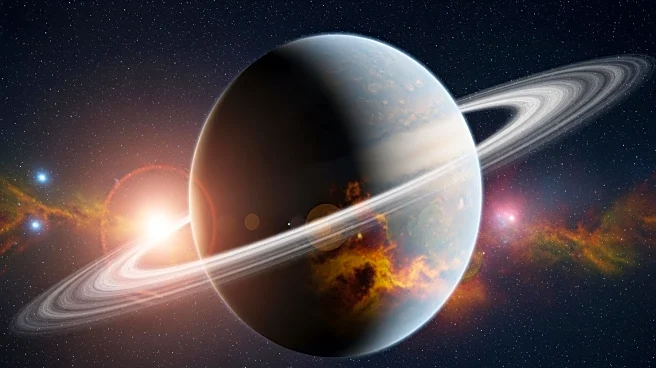
Astronomers have discovered a new super-Jupiter, named TIC-65910228 b, orbiting a metal-rich sun-like star located 864 light years away. This discovery was made using NASA’s Transiting Exoplanet Survey Satellite (TESS) and was published on the arXiv pre-print
server. TIC-65910228 b is nearly five times the mass of Jupiter and has a radius slightly larger than Jupiter. The planet orbits its star at a distance of 0.7 astronomical units, completing one orbit every 180.53 days, classifying it as a warm-Jupiter. The discovery was confirmed through additional observations using photometric and spectroscopic methods, involving instruments like the Next Generation Transit Survey (NGTS) and high-precision spectrometers such as HARPS and CORALIE.
Why It's Important?
The discovery of TIC-65910228 b is significant as it expands the understanding of gas giants and their environments. The planet's moderate temperature and size make it a promising candidate for future atmospheric research, potentially revealing new insights into the composition and behavior of exoplanetary atmospheres. The possibility of moons and rings around TIC-65910228 b also opens new avenues for exploration, as these features could provide valuable information about the formation and evolution of planetary systems. The study of such distant exoplanets can enhance the understanding of the dynamic processes at play in other star systems, contributing to the broader field of exoplanetary science.
What's Next?
Future research on TIC-65910228 b may involve next-generation space telescopes capable of probing deeper into its atmosphere. The search for additional planets in the system could provide further insights into the architecture of planetary systems beyond our own. The potential presence of exomoons or rings around TIC-65910228 b makes it an exciting target for future exploration, particularly with advanced telescopes that could detect such smaller companions. These efforts could significantly contribute to the understanding of habitable environments beyond Earth.
Beyond the Headlines
The discovery of TIC-65910228 b highlights the potential for finding stable exomoon or ring systems, which are key areas of interest in the search for extraterrestrial life. The presence of such features could suggest habitable environments, making planets like TIC-65910228 b important targets for future missions. Additionally, the study of long-period transiting planets like TIC-65910228 b can provide valuable insights into the dynamics of planets in longer orbits, which are relatively rare in current data.