
What's Happening?
Russia has secured a patent for a rotating space station designed to generate artificial gravity, a significant development in addressing the physical challenges of long-term space travel. The design,
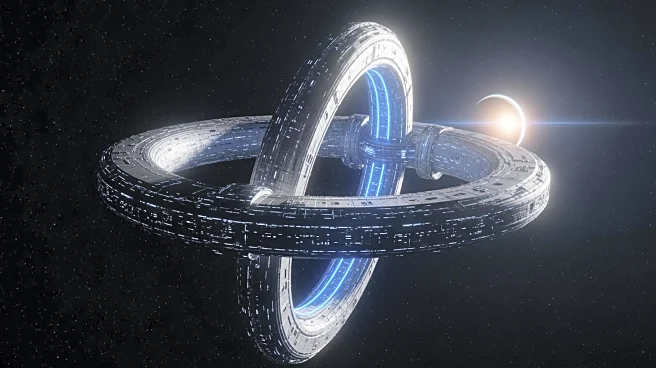
patented by the Russian state rocket company Energia, aims to simulate 0.5g, or half of Earth's gravity, to mitigate the adverse effects of zero gravity on the human body. This innovative structure is described as a massive, modular rotating system that resembles a high-speed fan, with habitable modules extending outward like spokes on a wheel. The station's design is intended to provide a permanent solution for astronauts facing the physical rigors of extended orbital stays or interplanetary travel. Although no specific resources or timelines have been committed to the project, the patent signals Russia's intent to advance in the new space race, especially as the International Space Station (ISS) approaches its decommissioning in 2030.
Why It's Important?
The development of a space station with artificial gravity is a potential game-changer for deep-space exploration. It addresses one of the most significant biological challenges of space travel: the deterioration of the human body in zero gravity. Currently, astronauts on the ISS must exercise extensively to maintain muscle and bone strength. By providing a simulated gravitational environment, Russia's design could reduce the need for such rigorous physical maintenance, making long-term missions more feasible. This advancement could enhance Russia's position in the global space race, particularly as international collaborations like the ISS wind down. The move also reflects a shift towards more independent and technologically advanced space exploration efforts by Russia.
What's Next?
While the patent marks a significant step, the actual construction and deployment of such a space station present substantial engineering challenges. The station's size would require multiple rocket launches and complex assembly in orbit. Safety concerns, particularly regarding docking with a constantly spinning structure, must be addressed to prevent catastrophic collisions. As Russia plans to exit the ISS by 2028, this project could signify a strategic pivot towards developing its own space infrastructure. Additionally, other countries and private companies, like the American firm Vast, are also exploring artificial gravity solutions, indicating a competitive landscape in this area of space technology.