


What's Happening?
U.S. Senator Jacky Rosen (D-NV) recently met with Sylvie Bedard, the Consul General of Canada in Los Angeles, to address growing trade tensions between the United States and Canada. The meeting, which took place last week, occurred as both countries were
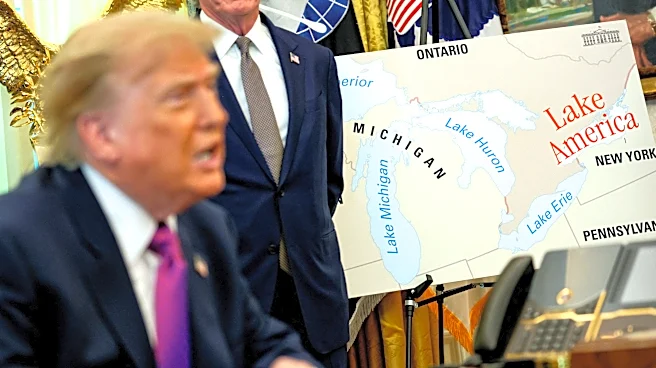
engaged in a period of trading tariffs throughout August. Senator Rosen emphasized the importance of the relationship between the two nations, particularly highlighting Canada's critical role in Nevada's economy. She stated that Nevada's tourism, manufacturing, and agriculture sectors heavily rely on Canadian visitors and imports. Senator Rosen openly criticized President Trump's actions, describing his 'reckless attacks' on Canada, a strong ally and major trading partner, as needlessly harming businesses, increasing prices, and decreasing tourism. She affirmed her commitment to ensuring a healthy and fair relationship with Canada and expressed her satisfaction with the meeting with the Consul General.
Why It's Important?
This meeting is significant as it underscores the economic impact of international trade tensions on U.S. states, particularly Nevada. Canada is a vital trading partner for the U.S., and disruptions in this relationship, such as tariffs, can have tangible negative consequences on various sectors. For Nevada, the reliance on Canadian tourism and imports means that trade disputes can directly affect local businesses, employment, and consumer prices. Senator Rosen's public criticism of President Trump's trade policies highlights a divergence in approach within U.S. political circles regarding international trade and alliances. Her advocacy for a 'healthy, fair relationship' with Canada reflects a broader concern among some lawmakers about the long-term implications of protectionist trade measures on U.S. economic stability and diplomatic standing. The meeting also serves as an attempt to mitigate the negative effects of these tensions at a regional level, demonstrating how state-level representatives engage in foreign policy discussions to protect their constituents' economic interests.
What's Next?
Following Senator Rosen's meeting, it is anticipated that she will continue to advocate for policies that promote stable and fair trade relations between the U.S. and Canada. Her office may engage in further discussions with relevant U.S. trade officials and congressional committees to address the ongoing tariff disputes. The public criticism of President Trump's trade policies suggests that this issue could remain a point of contention in national political discourse, potentially influencing future trade negotiations and electoral campaigns. Businesses in Nevada, particularly those in tourism, manufacturing, and agriculture, will likely monitor these developments closely, as their economic well-being is directly tied to the U.S.-Canada trade relationship. The Consul General of Canada will likely relay the sentiments expressed by Senator Rosen back to Canadian officials, potentially informing their diplomatic strategies. The broader U.S.-Canada trade relationship will continue to be shaped by ongoing negotiations and the political climate in both countries, with potential for either escalation or de-escalation of tensions depending on future policy decisions.
Beyond the Headlines
This event highlights the complex interplay between federal trade policy and regional economic realities. While national trade policies are set at the federal level, their effects are deeply felt by local economies and specific industries. Senator Rosen's intervention demonstrates how individual states and their representatives can become active participants in international relations when their economic interests are at stake. The discussion also touches upon the broader debate about the value of alliances versus protectionism in global trade. The Senator's emphasis on Canada as a 'strongest ally' suggests a perspective that views trade not just as an economic transaction but as an integral part of geopolitical strategy and alliance building. This incident could also prompt a re-evaluation of how U.S. trade policies are formulated, potentially leading to greater consideration of their localized impacts and the input of state-level stakeholders. The long-term implications could include a push for more nuanced trade agreements that balance national interests with the specific needs of diverse U.S. industries and regions.