



What's Happening?
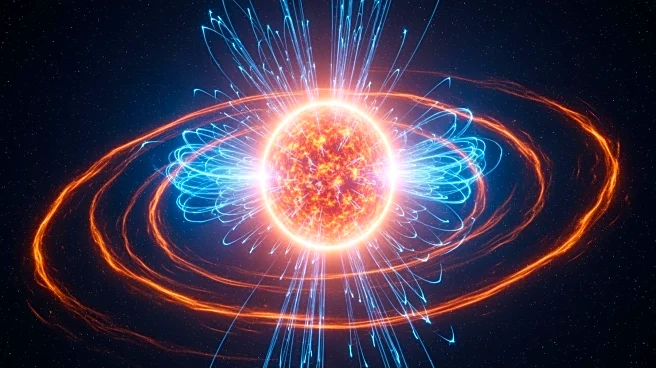
Astronomers have observed a neutron star, known as NGC 7793 P13, located in the galaxy NGC 7793, approximately 10 million light-years from Earth, as it undergoes a significant transformation. This neutron star, which had been in a faint phase in 2021,
began to brighten in 2022 and reached a high luminosity by 2024, more than two orders of magnitude higher than in 2021. The research team utilized data from XMM-Newton, Chandra, NuSTAR, and NICER to study the long-term evolution of the X-ray luminosity and rotation period of P13 from 2011 to 2024. The findings suggest a relationship between X-ray luminosity and rotation velocity, indicating changes in the accretion system during the faint phase. The study also noted that the height of the accretion column changed with the 10-year flux modulation, providing insights into the mechanism of supercritical accretion.
Why It's Important?
This discovery is significant as it provides new insights into the process of supercritical accretion, a phenomenon where an extraordinary amount of gas falls onto a compact object like a neutron star, emitting intense X-rays. Understanding this process is crucial for astrophysics, as it can help explain the behavior of other similar cosmic objects and the dynamics of galaxies. The findings could also contribute to the broader understanding of how matter behaves under extreme gravitational forces, potentially impacting theories related to black holes and neutron stars. This research enhances our knowledge of the universe's fundamental processes, which could have implications for future space exploration and the study of cosmic phenomena.
What's Next?
The research team plans to continue monitoring NGC 7793 P13 to further understand the relationship between X-ray luminosity and rotation velocity. Future studies may focus on the detailed analysis of the accretion column's height changes and their impact on the neutron star's behavior. These observations could lead to a deeper understanding of supercritical accretion and its role in the evolution of neutron stars. Additionally, the findings may prompt further investigations into other neutron stars exhibiting similar characteristics, potentially leading to new discoveries in the field of astrophysics.