





What's Happening?
A recent study published in iScience indicates that mosquitoes are selectively attracted to humans based on individual skin scent and microbiomes. Lead researcher Matthew DeGennaro found that while there isn't a universal 'mosquito magnet,' specific mosquito species
show preferences. For instance, Aedes aegypti, a vector for Zika and dengue, favored male participants and individuals with higher levels of Staphylococcus bacteria but lower levels of cyclic alcohols. Aedes albopictus was drawn to abundant bacteria, odors, and ketones, while Culex quinquefasciatus avoided odors but liked chemicals found in essential oils. The study, conducted in Florida, tested the attraction of these three species to 119 human participants. Participants wore nylon sleeves to capture skin odor and microbes after not washing for 12 to 16 hours, and their arms were then exposed to mosquitoes in a uniport olfactometer to measure attraction levels. These findings suggest that the unique composition of an individual's skin scent and microbiome, influenced by diet and health, plays a crucial role in mosquito attraction.
Why It's Important?
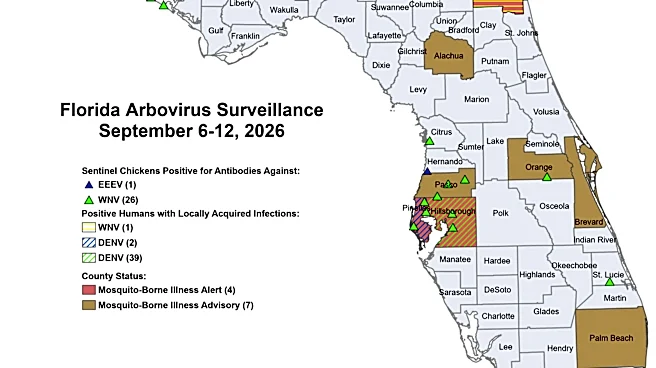
This research is significant for public health in the U.S., particularly in regions like Florida where these mosquito species pose high health risks by transmitting diseases such as Zika virus, dengue fever, and West Nile virus. Understanding the specific factors that attract different mosquito species to humans could revolutionize the development of targeted mosquito repellents. Current repellents offer a general defense, but this study opens the door for personalized or species-specific solutions. If scientists can identify and manipulate the specific skin compounds that attract or repel certain mosquitoes, it could lead to more effective and long-lasting protective measures. This could reduce the incidence of mosquito-borne illnesses, lessen the burden on healthcare systems, and improve quality of life in affected areas. The potential for a 'living probiotic cream repellent' mentioned by DeGennaro could offer a novel, continuously produced defense against mosquito bites, moving beyond the limitations of current topical applications.
What's Next?
The immediate next step for researchers is to leverage these findings to develop more targeted mosquito repellents. DeGennaro suggests the possibility of creating universal microbes that could be modified into a 'living probiotic cream repellent.' This innovative approach would involve applying a cream to the skin that continuously produces repellent compounds, potentially offering more effective and sustained protection than existing products. Further research will likely focus on identifying the precise chemical compounds and microbial interactions that drive mosquito attraction for each species. This could lead to the development of new active ingredients for repellents or even methods to alter human skin microbiomes to make individuals less attractive to disease-carrying mosquitoes. While the study doesn't offer immediate advice for individuals to reduce their attractiveness, future developments could provide practical, personalized strategies for mosquito bite prevention.
Beyond the Headlines
The study's insights into the complex interplay between human skin, microbiomes, and mosquito attraction highlight a deeper biological understanding of disease vectors. This research moves beyond simple assumptions about mosquito preferences, revealing a nuanced biological mechanism. The concept of a 'living probiotic cream repellent' introduces an ethical and regulatory dimension, as it involves altering the human microbiome for disease prevention. This could lead to discussions about the long-term effects of such interventions on human health and the environment. Furthermore, as climate change expands mosquito habitats and increases the prevalence of mosquito-borne diseases, this research underscores the urgent need for innovative solutions. The findings could also influence urban planning and public health strategies, guiding efforts to mitigate mosquito populations by understanding their behavioral ecology more thoroughly. This scientific advancement could shift the paradigm of mosquito control from broad-spectrum approaches to highly specific, biologically informed interventions.