







What's Happening?
Maria Bartiromo has announced her departure from Fox News after more than 12 years with the network. Fox confirmed her exit on Thursday, September 3, without providing a specific reason. This move has immediately fueled speculation regarding her next
career step, particularly a potential role within the Trump administration. Bartiromo has maintained a close relationship with President Trump, frequently interviewing him and receiving public praise. This proximity has previously led to discussions about her possibly taking a government position. Reports from early 2025, cited by Politico reporter Alex Isenstadt, even suggested President Trump considered Bartiromo as a potential vice-presidential candidate. Her departure will impact her two main Fox programs: 'Mornings With Maria' on Fox Business, which will be rebranded as 'Mornings with Fox Business' with rotating hosts, and her Sunday program, 'Sunday Morning Futures,' which will also feature rotating presenters, with Jason Chaffetz scheduled to host the upcoming edition. Neither Bartiromo nor her representatives have publicly disclosed her future plans.
Why It's Important?
Maria Bartiromo's departure from a prominent news network like Fox News, coupled with the immediate speculation about a role in the Trump administration, highlights the intricate relationship between media personalities and political power in the U.S. Her close ties to President Trump and the public nature of their interactions underscore a trend where media figures can transition into political roles, blurring the lines between journalism and political service. This situation is significant for the media landscape, as it raises questions about journalistic impartiality and the potential for news anchors to leverage their platforms for political advancement. For the Trump administration, if such a move were to occur, it could signal a strategic choice to bring in a familiar and trusted media voice, potentially to enhance communication efforts or fill key positions. Conversely, the absence of a clear explanation for her departure from Fox News could lead to further public and media scrutiny regarding the circumstances and motivations behind her decision, impacting public perception of both the individual and the institutions involved.
What's Next?
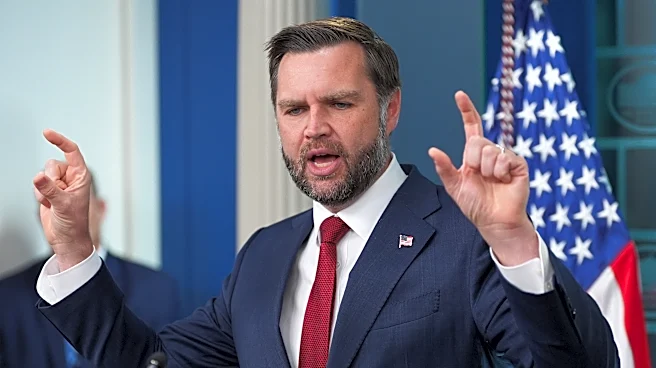
The immediate next steps involve the transition of her programs at Fox News, with 'Mornings With Maria' becoming 'Mornings with Fox Business' and 'Sunday Morning Futures' utilizing rotating hosts. The primary focus of speculation will be on Maria Bartiromo's official announcement regarding her future endeavors. While some reports, such as one from Aidan McLaughlin of Vanity Fair, suggest she is not leaving for a position in the Trump administration, the possibility remains a significant topic of discussion. Vice President JD Vance, when asked about Bartiromo potentially becoming the next White House press secretary, appeared to dismiss the idea, laughing off the question. However, New York Republican Rep. Nicole Malliotakis publicly entertained the notion, praising Bartiromo and suggesting she could be the next White House Press Secretary. Rep. Anna Paulina Luna also expressed affection for Bartiromo and indicated she would not be out of the public eye for long. The coming weeks are likely to bring clarity on Bartiromo's next professional move, which will either confirm or refute the ongoing speculation about her entry into the political arena.
Beyond the Headlines
The speculation surrounding Maria Bartiromo's potential transition from a high-profile media career to a role within the Trump administration touches upon deeper implications concerning the evolving nature of political communication and media influence. This scenario highlights the increasing fluidity between media and politics, where established journalists and commentators can become integral parts of political campaigns or administrations. Such transitions can raise ethical questions about the objectivity of news reporting, particularly when media figures maintain close relationships with political leaders. It also reflects a broader cultural shift where public figures from various sectors are increasingly seen as viable candidates for political appointments, potentially altering the traditional pathways to government service. The public's perception of media credibility could be affected, as the lines between news dissemination and political advocacy become less distinct. This development could further contribute to the polarization of media consumption, with audiences gravitating towards outlets and personalities that align with their political views, thereby reinforcing existing biases rather than fostering neutral information exchange.