





What's Happening?
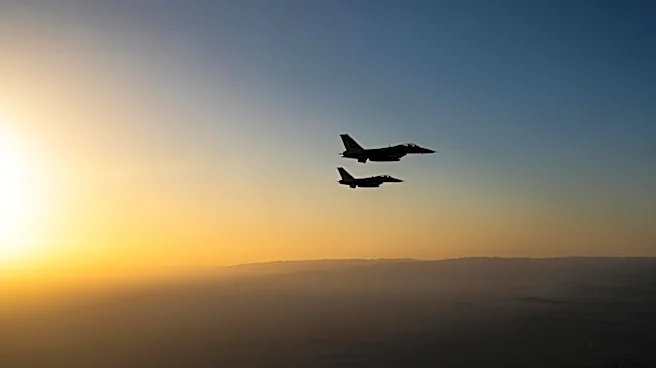
Egypt has deployed Dassault Rafale multirole fighters to the United Arab Emirates (UAE), as revealed by the UAE Ministry of Defence on May 7, 2026. This deployment comes in the context of heightened tensions with Iran, which has been accused of attacking
the UAE. Egyptian President Abdel Fattah el-Sisi and Emirati President Sheikh Mohamed bin Zayed al-Nahyan conducted an inspection visit to the Egyptian fighter detachment stationed in the UAE. The visit underscored Egypt's support for the UAE's stability and security, rejecting Iran's actions as violations of international law. Egypt, a significant customer of the Rafale jets, had previously ordered 24 in 2015 and another 30 in 2021. The UAE also placed an order for 80 Rafales in 2021, with the first delivery occurring in January 2025.
Why It's Important?
The deployment of Egyptian Rafale fighters to the UAE signifies a strategic military alignment between Egypt and the UAE amidst regional instability. This move highlights the growing military cooperation in the Middle East, particularly in response to perceived threats from Iran. The presence of Egyptian forces in the UAE could serve as a deterrent against further aggression from Iran, potentially stabilizing the region. For Egypt, this deployment reinforces its role as a key military player in the Middle East, while for the UAE, it strengthens its defense capabilities. The situation also underscores the broader geopolitical dynamics in the region, where alliances are being tested and redefined in response to evolving threats.
What's Next?
The deployment may lead to further military collaborations between Egypt and the UAE, potentially involving joint exercises or additional deployments. The international community, particularly Western allies, may closely monitor these developments, given the strategic importance of the Gulf region. Iran's response to this deployment will be crucial, as it could either escalate or de-escalate tensions. Diplomatic efforts may be intensified to address the underlying issues and prevent further conflict. Additionally, this situation could influence future arms deals and military strategies in the region, as countries reassess their defense postures in light of new threats.