

What's Happening?
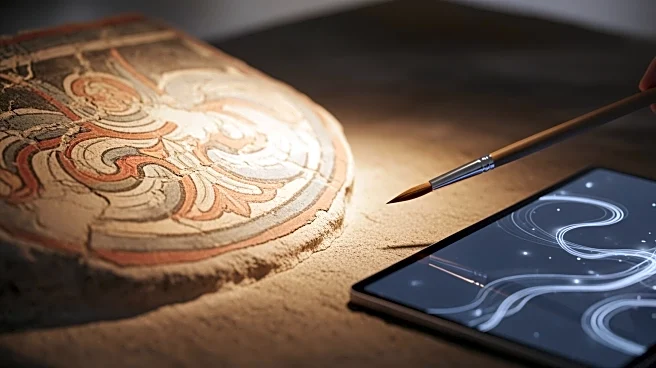
A new diffusion model named DiffuMural has been developed to restore damaged Dunhuang murals using multi-scale convergence and cooperative guidance. This model integrates mask-driven spatial encoding, multi-scale collaborative diffusion, and frequency-domain
refinement to achieve high-fidelity restoration. The process involves extracting spatial location encodings of damaged regions to guide the diffusion process, progressively optimizing image structures from low to high resolution, and refining textures using frequency-domain processing. The model aims to restore murals in a way that is visually coherent and stylistically faithful to the original art, addressing challenges such as large-area degradation and the absence of ground-truth reference images.
Why It's Important?
The restoration of cultural heritage, such as the Dunhuang murals, is crucial for preserving historical and artistic legacies. The DiffuMural model represents a significant advancement in digital restoration technology, offering a method that respects the cultural and stylistic nuances of the original works. By improving the accuracy and quality of mural restoration, this technology can enhance the preservation of cultural artifacts, making them accessible to future generations. Additionally, the interdisciplinary approach combining computer vision, art history, and heritage conservation could set a precedent for future restoration projects.
Beyond the Headlines
The development of DiffuMural highlights the intersection of technology and cultural preservation, raising questions about the role of digital tools in heritage conservation. While the model offers a non-invasive method for restoration, it also prompts discussions about authenticity and the ethical implications of using AI in art restoration. The balance between technological intervention and maintaining the integrity of original artworks is a critical consideration for conservators and cultural institutions.