
What's Happening?
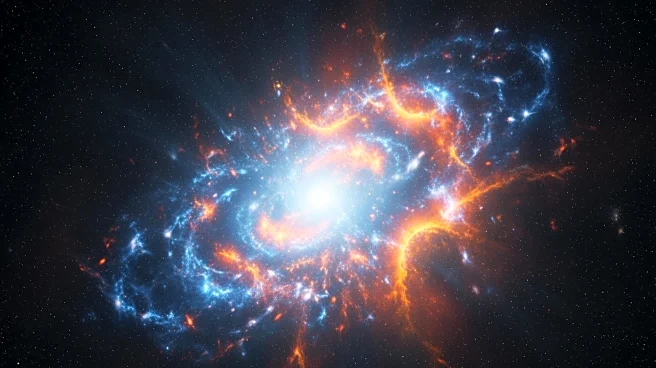
The Hubble Space Telescope has revisited the Crab Nebula, a supernova remnant located 6,500 light-years away in the constellation Taurus, to observe its expansion over the past 25 years. Originally linked to historical records by Edwin Hubble, the Crab Nebula is the aftermath
of a supernova observed in 1054. The recent observations by Hubble have provided an unparalleled, detailed look at the nebula's evolution, capturing the movement of its filamentary structure at a pace of 5.5 million kilometers per hour. The new images reveal changes in the local temperature, density, and chemical composition of the gas. The observations also offer insights into the 3D structure of the nebula, with some filaments casting shadows onto the nebula's interior haze. The study, published in The Astrophysical Journal, highlights the unique capabilities of Hubble in capturing these detailed changes over time.
Why It's Important?
The Hubble Space Telescope's observations of the Crab Nebula are significant for understanding the long-term evolution of supernova remnants. By providing detailed insights into the nebula's structure and expansion, these observations help astronomers better understand the processes that occur after a supernova explosion. The data can be combined with observations from other telescopes, such as the James Webb Space Telescope, to create a more comprehensive picture of the supernova's aftermath. This research contributes to the broader field of astrophysics by enhancing knowledge about the life cycle of stars and the dynamics of pulsar wind nebulae. The findings have implications for understanding the distribution of elements in the universe and the mechanisms driving cosmic phenomena.
What's Next?
Future research will likely involve comparing Hubble's observations with data from other telescopes observing the Crab Nebula in different wavelengths of light. This multiwavelength approach will help scientists develop a more complete understanding of the nebula's structure and the processes driving its expansion. Continued monitoring of the Crab Nebula and similar supernova remnants will provide further insights into the life cycles of stars and the evolution of the universe. The integration of data from various telescopes will enhance the ability to model and predict the behavior of such cosmic phenomena.