



What's Happening?
U.S. House Representative Ronny Jackson (R-TX13) has announced $9.75 million in federal funding for West Texas A&M University. This significant grant, sourced from the U.S. Department of Agriculture’s National Institute of Food and Agriculture Research
Facilities Act Program, is earmarked for the university's developing Research Feedlot Complex. The total project, valued at $19.5 million, includes matching funds of $4.875 million from the Texas A&M University System and an additional $4.875 million from the Texas Cattle Feeders Association, WT donors, and other sources. The complex will feature a beef cattle handling facility, a veterinary hospital, a feed and production center, 90 research pens, 45 commercial-scale pens, and a metabolism and physiology center. Interim University President Neil Terry highlighted this as the largest federal grant in the university's history. Additionally, Representative Jackson also secured $2.1 million in fiscal year 2024 and $1 million in fiscal year 2026 for the Paul F. and Virginia J. Engler Foundation Feedlot Education Facility, which is part of the larger complex.
Why It's Important?
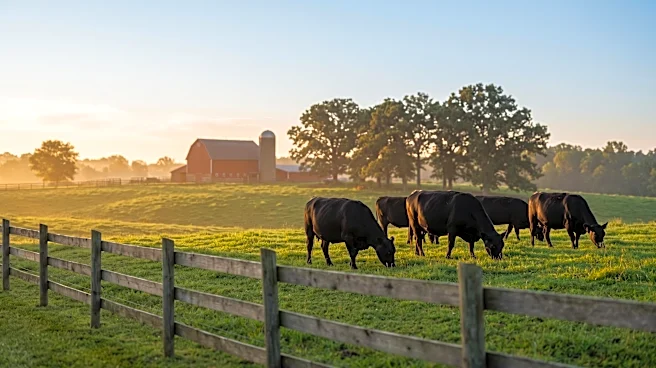
This federal funding is crucial for advancing beef cattle research and agricultural education in the U.S., particularly in the Texas Panhandle, a region central to the nation's cattle industry. The new Research Feedlot Complex at West Texas A&M University will significantly expand research capabilities, allowing for larger projects focused on cattle nutrition, health, and management strategies. This investment is expected to foster innovation by integrating traditional and AI-powered approaches to enhance beef production efficiency. For students, the facility will provide expanded hands-on experience, preparing them for careers in the feedlot industry. The Texas Cattle Feeders Association, whose members manage over three million cattle within a 150-mile radius of the university, stands to benefit directly from the research outcomes, which aim to ensure the continued production of high-quality beef. This initiative underscores the federal government's commitment to supporting agricultural science and the economic vitality of rural communities dependent on livestock farming.
What's Next?
Construction of the Paul F. and Virginia J. Engler Foundation Feedlot Education Facility, which includes office spaces, a classroom, and an event center, is estimated to be completed by June. The broader Research Feedlot Complex will continue its development, with the USDA funding allocated through September 30, 2028. Once operational, the complex will begin evaluating new techniques in beef production and feedlot management. The university anticipates that these new facilities will attract a greater number of agriculture students from across the U.S., further solidifying its role as a leading institution in agricultural education and research. The project also involves students from construction management and engineering programs, providing interdisciplinary educational opportunities. The ongoing research and educational programs are expected to yield advancements that will benefit the cattle-feeding industry for decades to come, contributing to the economic strength of the Texas Panhandle and the national agricultural sector.
Beyond the Headlines
The investment in West Texas A&M University's Research Feedlot Complex highlights a broader trend of integrating advanced technology, including artificial intelligence, into traditional agricultural practices. This move signifies a shift towards more data-driven and efficient farming methods, which could have far-reaching implications for food security, environmental sustainability, and economic competitiveness in the U.S. agricultural sector. The project also exemplifies the critical role of federal grants and public-private partnerships in fostering innovation and regional economic development. By focusing on beef cattle research, the initiative addresses the complex challenges of livestock production, including animal welfare, resource management, and market demands. Furthermore, the emphasis on student training ensures a pipeline of skilled professionals capable of navigating the evolving landscape of modern agriculture, thereby securing the future of a vital American industry. This collaborative effort underscores the interconnectedness of scientific research, education, and economic prosperity.