



What's Happening?
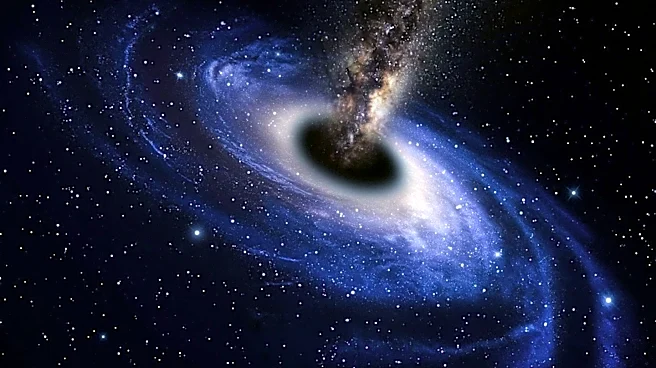
New research indicates that the 'burps' emitted by black holes when they feed on stars are remarkably similar, irrespective of the black hole's size. This finding, which has been difficult to test due to the vast timescales over which supermassive black holes evolve,
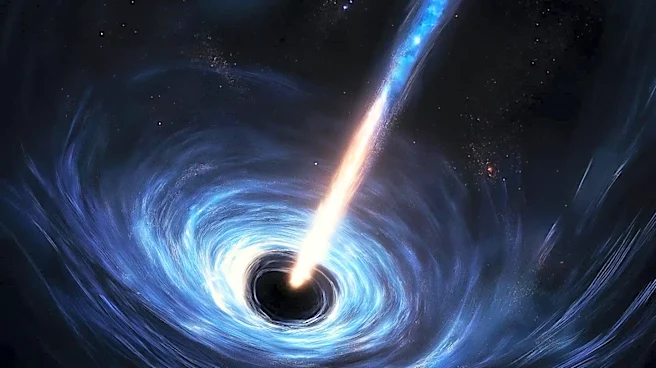
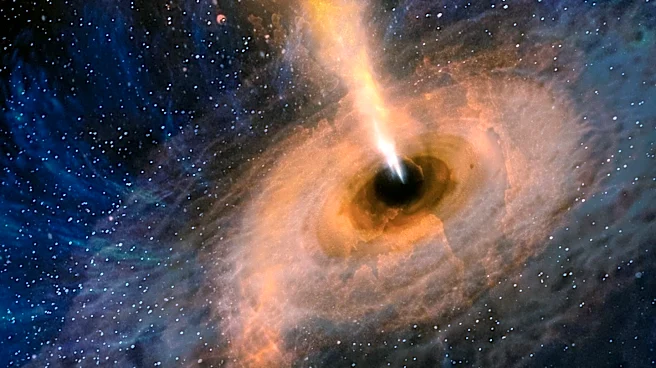
was made possible by studying tidal disruption events (TDEs). TDEs occur when a star gets too close to a black hole and is 'spaghettified' by immense tidal forces. During this process, the black hole 'spills' a significant amount of stellar material, which is then channeled to its poles and blasted out as near-light-speed jets, referred to as 'burps.' Andrew Mummery of the Institute for Advanced Study (IAS) School of Natural Sciences and Adelle J. Goodwin studied a sample of 20 TDEs using telescope data across various electromagnetic radiation wavelengths. They discovered that jet-launching occurs in two distinct phases: immediately after extreme feeding and much later, when the black hole's feeding drops to 2% of the Eddington limit. This 2% threshold is significant because it's the same point at which stellar-mass black holes launch their jets, suggesting a universal mechanism.
Why It's Important?
This discovery provides crucial evidence for the long-held theoretical idea that the underlying physics governing black holes remains consistent, regardless of their immense differences in size and mass. From stellar-mass black holes, a few times the mass of the sun, to supermassive black holes, billions of times larger, the mechanism for launching energetic jets appears to be the same. This uniformity simplifies our understanding of black hole behavior and offers a powerful tool for predicting when these 'burps' will occur. Since black hole jets are known to shape entire galaxies, influencing star formation and galactic evolution, a deeper understanding of their emission mechanisms has broad implications for astrophysics. It allows scientists to apply insights gained from observable TDEs to the much slower processes of supermassive black holes, bridging a significant gap in cosmic understanding.
What's Next?
The researchers hope that their work will lead to more profound discoveries about the universe. With the established consistency in jet-launching behavior, astronomers will be better equipped to predict when jets will be launched during future TDEs. This predictive capability will enable more targeted observations and detailed studies of these events, potentially unraveling the remaining mysteries surrounding the exact mechanism that powers these jets and the delay between black holes feeding and launching them. Further research will likely involve analyzing more TDEs and refining models to incorporate this universal physics, ultimately enhancing our ability to understand the energetic processes that shape galaxies and the distribution of matter in the cosmos.
Beyond the Headlines
The finding that black hole 'burps' are governed by universal physics, regardless of scale, is a testament to the elegance and consistency of the laws of nature. It suggests that despite the extreme conditions within and around black holes, there are fundamental principles that apply across all sizes. This insight could have implications for theoretical physics, potentially informing models that seek to unify different aspects of gravity and quantum mechanics. Furthermore, the ability to predict black hole jet activity could lead to a better understanding of high-energy phenomena in the universe, including the origin of cosmic rays and other energetic particles. This research underscores the power of studying extreme cosmic events like TDEs to unlock fundamental truths about the universe's most enigmatic objects.