





What's Happening?
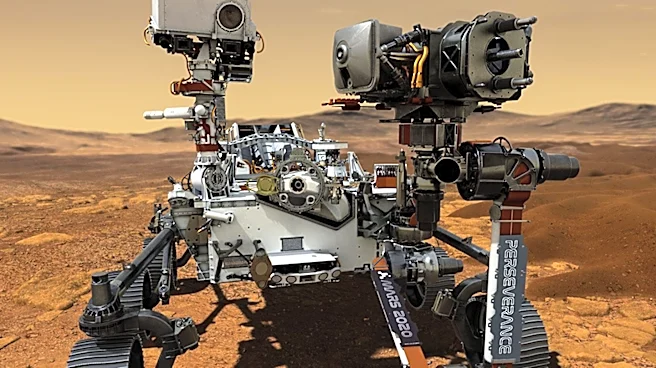
NASA's Perseverance rover has made one of the most extensive detections of complex organic carbon on Mars. These findings, published in Science Advances, reveal macromolecular carbon—large, tangled networks of carbon atoms—within mudstones in an ancient
dried-up river channel in Jezero Crater. The carbon was found in two rocks from the Bright Angel formation in Neretva Vallis, a channel that once fed a lake. This marks the only known detection of macromolecular carbon on a natural rock surface on Mars. The SHERLOC instrument, utilizing an ultraviolet laser and fluorescence spectroscopy, identified complex carbon in both sedimentary minerals and later-forming carbonate and sulfate minerals. This suggests the carbon was incorporated into the rock at multiple stages: during initial sediment deposition and later through groundwater alteration. While the discovery is significant, it does not definitively confirm whether the molecules originated from biological or non-biological processes. This finding builds upon previous excitement from 2024 when Perseverance identified distinctive 'leopard spots' on rocks at the same site, which on Earth can be associated with microbial activity.
Why It's Important?
This discovery significantly strengthens the scientific case for the potential of past life on Mars. Organic molecules are fundamental building blocks of life, and their widespread presence in ancient river deposits suggests that conditions favorable for life may have existed on the Red Planet. While the origin of these molecules—biological, hydrothermal reactions, or delivery by meteorites—remains undetermined, their existence in such quantities in a former water-rich environment is a crucial piece of the puzzle. The findings underscore the importance of the Mars sample-return mission, as laboratory analysis on Earth would be necessary to determine the precise chemical structures of these organic compounds. Such detailed analysis, beyond the rover's current capabilities, could provide definitive answers about ancient geological activity, prebiotic chemistry, or even direct evidence of past microbial life, profoundly impacting our understanding of life beyond Earth.
What's Next?
The immediate next step involves the continued collection and caching of samples by the Perseverance rover. The rover has already sealed over two dozen samples for retrieval by a future Mars sample-return mission. The ultimate goal is to bring these samples back to Earth for in-depth laboratory analysis. Scientists on Earth will then be able to employ advanced techniques to determine the precise chemical structures of the organic compounds found. This detailed examination will be crucial in distinguishing between biological and non-biological origins for the carbon. The results of these analyses will guide future astrobiological research and potentially influence the design and objectives of subsequent Mars missions, focusing on areas with the highest potential for preserving biosignatures. The scientific community will be eagerly awaiting the return of these samples to unlock further secrets of Mars' past.
Beyond the Headlines
The detection of extensive organic carbon on Mars carries profound implications beyond the immediate scientific findings. It reignites philosophical and existential questions about the uniqueness of life in the universe. If life, or the building blocks of life, can arise on another planet within our solar system, it suggests that life might be a more common phenomenon than previously thought. This discovery could also influence future space exploration strategies, potentially shifting focus towards missions designed to detect extant life or more complex biosignatures. Ethically, confirming past Martian life would necessitate a re-evaluation of planetary protection protocols and our approach to potential extraterrestrial ecosystems. Culturally, such a discovery would undoubtedly spark widespread public interest and could inspire a new generation of scientists and explorers, fundamentally altering humanity's perception of its place in the cosmos.