




What's Happening?
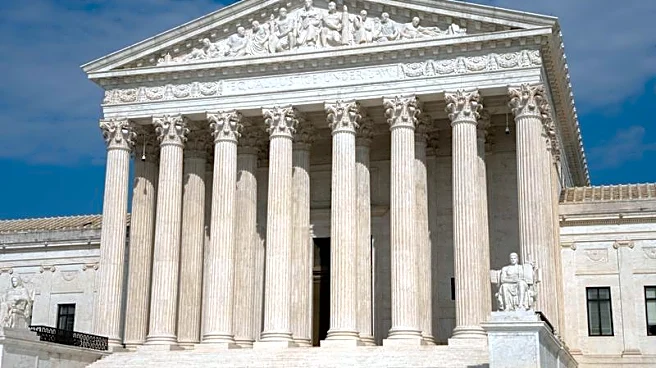
House Democrats recently voted down a proposed constitutional amendment that aimed to permanently set the number of Supreme Court justices at nine. The vote, which failed to reach the two-thirds majority required for a constitutional amendment, was 212-206,
with nearly all House Democrats opposing the measure. House Minority Whip Katherine Clark (D-MA) urged her caucus to vote 'no,' arguing that the amendment would strip Congress of its constitutional authority to determine the size of the Supreme Court. She also stated that focusing on this issue would divert attention from other pressing matters, such as affordability. The size of the Supreme Court has been nine justices since 1869, but the Constitution does not specify this number, leaving it to Congress to decide. Historically, the court's size has changed several times since its initial establishment with six justices in 1789.
Why It's Important?
This vote highlights the ongoing political debate surrounding the structure and composition of the Supreme Court. The push for such an amendment stems from concerns among some lawmakers, particularly Republicans, that Democrats might attempt to expand the court (often referred to as 'court-packing') to shift its ideological balance. Democrats, on the other hand, view maintaining congressional authority over the court's size as crucial for legislative flexibility and as a check on judicial power. The debate reflects deep partisan divisions over the judiciary's role and its perceived political leanings. The outcome of this vote ensures that the option to alter the number of justices remains a legislative possibility, keeping the issue alive in future political discourse and potentially influencing judicial appointments and legislative strategies.
What's Next?
While this specific amendment has been defeated, the debate over the Supreme Court's size is likely to continue, especially as judicial decisions on contentious issues draw public and political scrutiny. Proponents of court expansion may continue to advocate for legislative action to increase the number of justices, particularly if they gain more political power. Conversely, those who favor a fixed nine-justice court may seek other legislative or political avenues to prevent expansion. The issue could become a significant talking point in future election cycles, influencing voter turnout and candidate platforms. Any future attempts to alter the court's size would require significant political will and likely face intense partisan opposition, making it a persistent point of contention in U.S. politics.
Beyond the Headlines
The discussion around the Supreme Court's size delves into fundamental questions about the balance of power within the U.S. government and the independence of the judiciary. The historical precedent of altering the court's size, often for political reasons, underscores the tension between judicial impartiality and political influence. This debate also touches upon the broader public trust in institutions; proposals to change the court's composition can be seen as either necessary reforms to ensure fairness or as partisan attempts to undermine judicial independence. The long-term implications could include a more politicized judiciary, where the court's composition becomes a regular battleground for political parties, potentially eroding its perceived legitimacy and its role as an impartial arbiter of law.