
What's Happening?
In early June 2026, a celestial event is captivating sky watchers as Jupiter aligns with the star Pollux in the constellation Gemini. This alignment is part of a larger astronomical display involving three
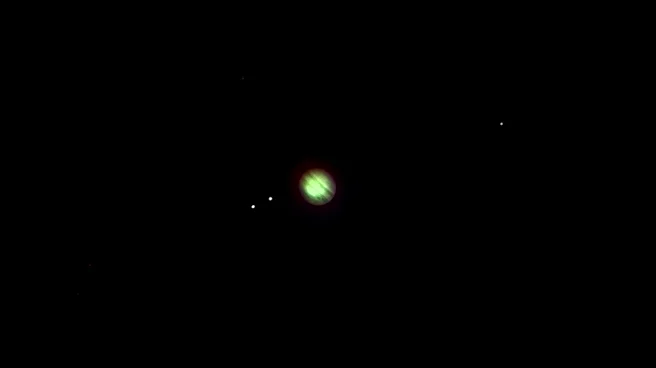
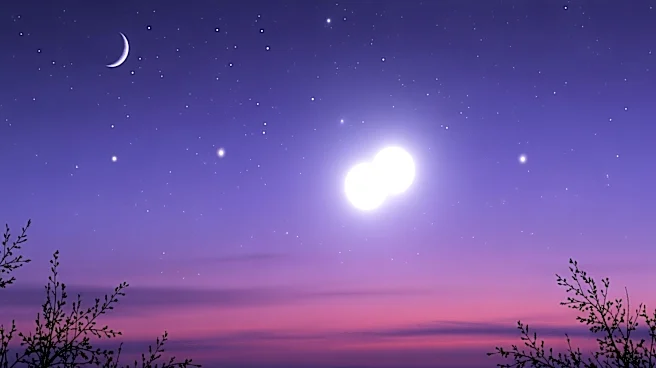
bright planets—Jupiter, Venus, and Mercury—visible in the evening sky. On June 4, Jupiter passes due south of Pollux, maintaining its position throughout the evening. This alignment is visible after sunset, with Mercury setting first, followed by Venus and Jupiter. The planets are positioned in a line from lower right to upper left, with Mercury closest to the horizon, Venus in the middle, and Jupiter to the upper left. The event provides an opportunity for observers to view these planets in conjunction with the stars Castor and Pollux, the heads of Gemini. Additionally, the bright star Procyon in Canis Minor is visible above the horizon, adding to the spectacle.
Why It's Important?
This celestial event is significant for both amateur and professional astronomers, offering a rare opportunity to observe multiple planets in close proximity to notable stars. Such alignments are not only visually striking but also provide valuable opportunities for educational outreach and public engagement with astronomy. The visibility of these planets and stars in the evening sky can inspire interest in space science and foster a greater appreciation for the night sky. For astronomers, these alignments can aid in the study of planetary motion and the dynamics of celestial bodies. The event also highlights the importance of preserving dark skies, as light pollution can hinder the ability to observe such phenomena.
What's Next?
Following this alignment, observers can look forward to additional celestial events throughout June 2026. Mars will become more prominent in the predawn sky, rising earlier and providing another opportunity for observation. As the month progresses, the Moon will also play a role in the night sky, with its phases offering different viewing conditions. Astronomers and enthusiasts will continue to monitor these events, using them as opportunities to engage the public and promote interest in astronomy. The ongoing visibility of these planets and stars will encourage continued observation and study, contributing to a deeper understanding of our solar system and the universe.