






What's Happening?
European courts are currently grappling with the legal conflict between an individual's 'right to be forgotten' and the Catholic Church's religious freedom concerning baptismal records. This issue arises from requests by baptized individuals to have their
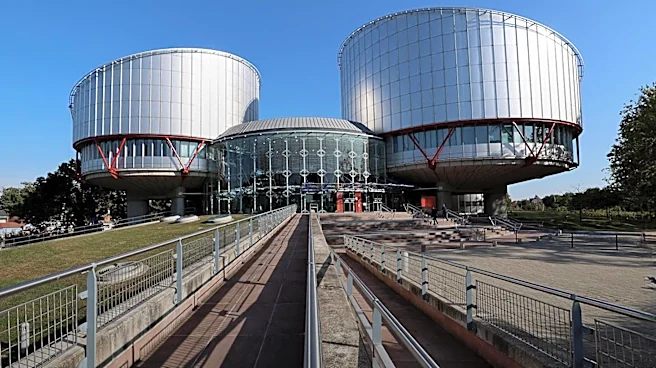
personal data completely erased from baptismal registers, citing Article 17 of the General Data Protection Regulation (GDPR). The Church, however, maintains that baptism is an indelible sacrament and that baptismal registers are historical records, not membership lists, thus refusing complete erasure. In France, an individual's request for complete removal was denied by national courts, leading to an appeal to the European Court of Human Rights (ECHR). Simultaneously, in Belgium, the Diocese of Ghent is challenging a Data Protection Authority order to erase data from a baptismal register, with the case referred to the Court of Justice of the European Union (CJEU). The Commission of the Bishops’ Conferences of the European Community (COMECE) has issued a position paper supporting the Church's autonomy in this matter.
Why It's Important?
This legal debate holds significant implications for the intersection of individual data privacy rights and religious freedom within the European Union. The rulings from the ECHR and CJEU will establish precedents that could affect how religious institutions manage their records and interact with data protection laws across Europe. For individuals, the outcome will clarify the extent to which they can exercise their 'right to be forgotten' in a religious context. For religious organizations, particularly the Catholic Church, the decisions will define the boundaries of their autonomy in maintaining sacred records and practices. A ruling favoring complete erasure could force churches to fundamentally alter long-standing traditions and record-keeping methods, potentially impacting their ability to document historical facts and administer sacraments according to their doctrine. Conversely, a ruling upholding the Church's stance could be seen as limiting individual data rights in specific religious contexts.
What's Next?
The next significant development will be the Opinion of Advocate General Laila Medina in the 'Bisdom Gent' case before the CJEU, scheduled for October 1, 2026. While not binding, this opinion will likely influence the CJEU's final decision. The CJEU's ruling will, in turn, be considered by the ECHR when it addresses the 'M.G. v. France' case, as both cases share similar legal grounds. These rulings will provide crucial clarifications on the scope of the 'right to be forgotten' in the context of religious freedom. The outcomes could lead to new legal frameworks or interpretations of existing data protection laws, potentially requiring religious institutions to adapt their practices or prompting further legislative action to balance these competing rights. Stakeholders, including religious organizations, data protection authorities, and civil liberties groups, will closely monitor these decisions for their far-reaching implications.
Beyond the Headlines
This legal battle delves into profound questions about identity, belief, and the role of religious institutions in a secularizing society. The concept of 'de-baptism' reflects a growing desire among some individuals to formally sever ties with religious affiliations, even those established in infancy. The Church's resistance highlights the theological significance of baptism as an indelible mark, a spiritual event that, from its perspective, cannot be undone or erased from historical record. This tension underscores a broader societal shift where individual autonomy and digital rights are increasingly asserted against traditional institutions and their practices. The European courts' decisions will not only have legal ramifications but also cultural and ethical implications, shaping the discourse around religious freedom, personal data ownership, and the evolving relationship between individuals and their spiritual heritage in the digital age. It forces a re-evaluation of what constitutes a 'record' and who has ultimate control over one's personal narrative, especially when it intersects with deeply held religious beliefs.