




What's Happening?
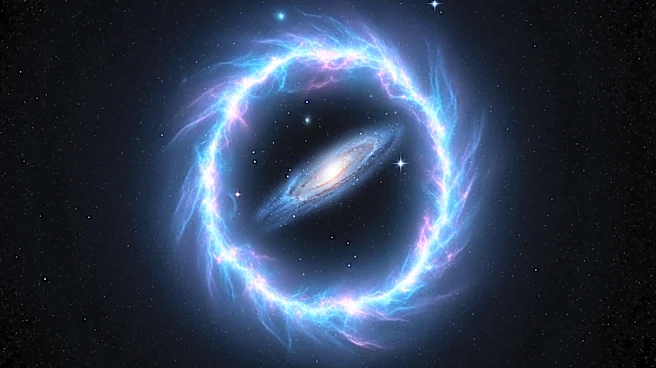
Astronomers have identified a rare 'Einstein Cross' gravitational lens, which has unveiled a young galaxy, J1453g, with unexpectedly mature stars. This galaxy, observed as it was 8 billion years ago, acts as a gravitational lens for a more distant quasar,
magnifying its light and causing it to appear multiple times in a cross shape. The discovery challenges existing models of galaxy formation, as J1453g's star composition is similar to the Milky Way, suggesting a more complex evolution of galaxies than previously thought. The research, led by Quirino D'Amato from the Italian National Institute for Astrophysics, highlights the potential for gravitational lensing to provide insights into the mass distribution and star formation in distant galaxies.
Why It's Important?
The discovery of J1453g and its mature stars in a young galaxy provides new insights into the processes of galaxy formation and evolution. It suggests that galaxies may develop in more complex ways than current models predict, potentially involving slower formation with higher mass stars or early transformations due to cosmic events like mergers. This finding could lead to revisions in our understanding of cosmic history and the development of massive structures in the universe. The use of gravitational lensing as a tool for such discoveries underscores its value in astrophysical research, offering a method to study distant cosmic phenomena that are otherwise beyond direct observation.
What's Next?
Future research will likely focus on further analyzing the mass distribution and star formation processes in J1453g to refine models of galaxy evolution. The findings may prompt additional studies using gravitational lensing to explore other distant galaxies and their development. As astronomers continue to utilize advanced telescopes like the James Webb Space Telescope, more discoveries of similar nature could emerge, potentially reshaping our understanding of the universe's history and the lifecycle of galaxies.