
What's Happening?
On November 26, 2025, photographer Valter Binotto captured a rare image of two of Earth's most elusive lightning phenomena, an elve and a sprite, simultaneously appearing in the night sky above northern
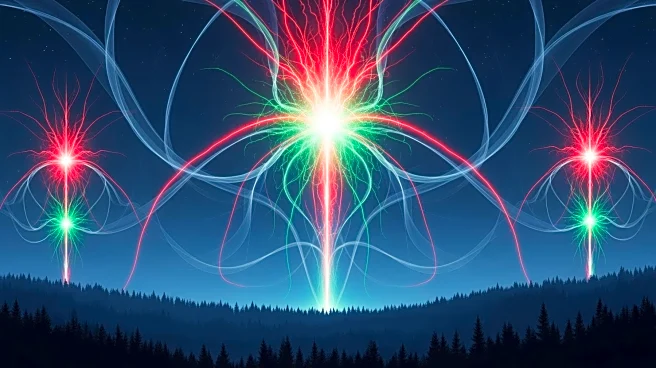
Italy. These phenomena, known as Transient Luminous Events (TLEs), occur high above thunderstorms. Elves manifest as vast, ghostly red rings that can span up to 300 miles and last less than a thousandth of a second. They are created when a powerful lightning strike sends an electromagnetic pulse into the ionosphere, causing nitrogen molecules to glow. Sprites, on the other hand, resemble crimson jellyfish or branching tendrils and are the most commonly observed TLEs, though they remain unpredictable and fleeting. Binotto's photograph, taken from his home in Possagno, Italy, is considered extraordinary due to the simultaneous capture of both phenomena, a feat rarely achieved.
Why It's Important?
The simultaneous capture of an elve and a sprite is significant for both scientific and photographic communities. These phenomena provide insights into the interactions between thunderstorms and Earth's upper atmosphere, which are not fully understood. Projects like Spritacular encourage photographers to document such events, aiding scientific research. Binotto's achievement highlights the potential for amateur photographers to contribute to scientific understanding. The rarity of these events and the difficulty in capturing them make this photograph a valuable asset for researchers studying atmospheric phenomena. Additionally, it underscores the importance of technological advancements in photography, which enable the documentation of fleeting natural events.
What's Next?
The photograph is likely to inspire further interest and research into Transient Luminous Events. Scientists may use this image to study the conditions that lead to the simultaneous occurrence of elves and sprites, potentially leading to new insights into atmospheric science. Photographers and enthusiasts may be motivated to participate in projects like Spritacular, contributing to a growing database of TLE images. This could enhance understanding of how these phenomena are triggered and their implications for atmospheric dynamics. The image may also prompt discussions on the role of citizen science in advancing scientific knowledge.