



What's Happening?
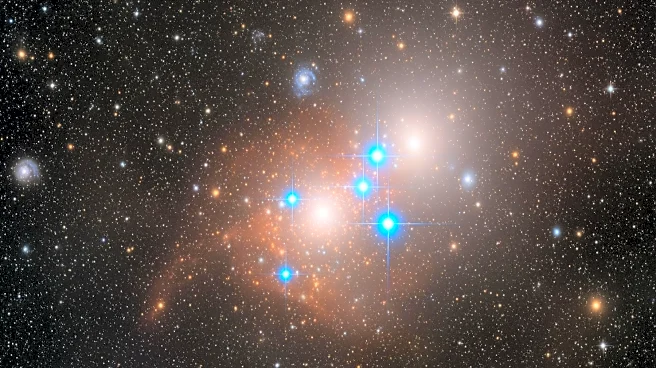
An international research team has used the Hubble Space Telescope to analyze ultraviolet observations of 48 globular clusters in the Milky Way, creating the largest catalog of blue straggler stars. These stars appear hotter, more massive, and younger
than their neighbors in ancient star clusters, defying standard theories of stellar aging. The study provides evidence that blue stragglers are formed through interactions in binary star systems rather than through stellar collisions. The findings show that blue stragglers are more common in low-density clusters, where binary systems are more likely to survive, challenging previous assumptions about their formation.
Why It's Important?
This discovery sheds light on the role of binary star systems in stellar evolution and highlights the influence of environmental conditions on star formation. Understanding the formation of blue stragglers helps astronomers comprehend how stars evolve over billions of years and the factors that can reset their stellar clocks. The findings also emphasize the importance of environmental conditions in shaping the life stories of stars, offering new insights into the dynamics of star clusters and the evolution of galaxies.
Beyond the Headlines
The study reveals that crowded star clusters are less conducive to the survival of binary systems, which are crucial for the formation of blue stragglers. This insight into the relationship between star environments and their evolution provides a new perspective on how stars interact and age. The research opens new paths for understanding stellar dynamics and the conditions that allow stars to appear younger than their actual age.