
What's Happening?
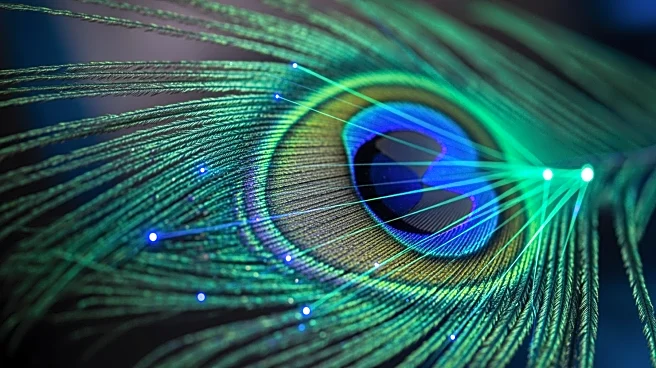
A recent study has revealed that peacock feathers, known for their vibrant iridescent colors, can emit laser light when treated with a common dye and excited by a green pulse. Researchers from Florida
Polytechnic University discovered that by soaking the feathers in rhodamine 6G dye and exposing them to 532 nanometer light, two narrow emission lines at 574 and 583 nanometers were produced, indicating true lasing. This phenomenon was observed in the green, yellow, and brown regions of the peacock's eyespot. The study suggests that the feathers' internal structures act as resonators, enabling this unique laser emission. This discovery opens up possibilities for new light sources that could be used safely with living tissues for sensing and imaging.
Why It's Important?
The ability of peacock feathers to emit laser light could have significant implications for the development of biocompatible light sources. Such lasers could be used in medical imaging and sensing technologies, offering a safer alternative to traditional lasers that might damage living tissues. The study highlights the potential of using biological materials in technological applications, which could lead to advancements in fields such as materials science and bioengineering. This research also underscores the importance of understanding natural structures and their potential applications in creating innovative technologies.
What's Next?
Further research is needed to identify the exact structures within the peacock feathers that enable laser emission and to understand how these structures can be manipulated or replicated. This could lead to the development of new materials and devices that utilize similar principles for various applications. The study's findings may inspire additional investigations into other biological materials that could serve as components in advanced technological systems.