




What's Happening?
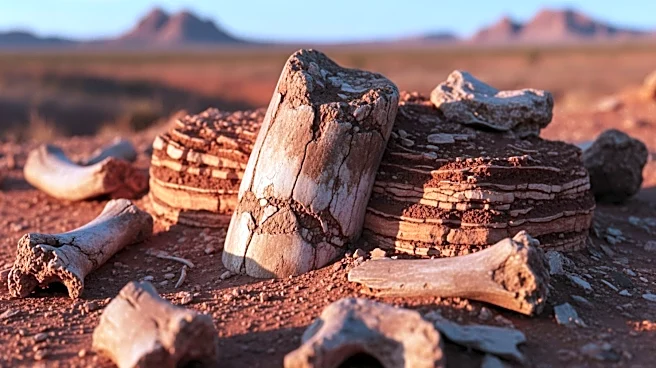
A recent study led by Dr. John Moretti from the University of Texas has uncovered remains of Ice Age megafauna in Bender's Cave, Texas, revealing a previously unknown ecosystem on the Edwards Plateau. The fossils include a giant tortoise (Hesperotestudo)
and a pampathere (Holmesina septentrionalis), suggesting a warm, wet, and forested environment during the late Pleistocene. This finding contrasts with previous records indicating a dry, cool grassland environment. The study, published in Quaternary Research, utilized hierarchical cluster analysis to compare these fossils with others from late Pleistocene sites across Texas, indicating they likely date to Marine Isotope Stage 3 or 5.
Why It's Important?
The discovery of these fossils challenges existing paleoclimate reconstructions for the Edwards Plateau, suggesting a different environmental history than previously thought. This has implications for understanding the geographic and temporal distribution of megafauna and their habitats during the Pleistocene. The findings could lead to a reevaluation of climate models and the ecological history of central Texas, impacting fields such as paleontology, climatology, and environmental science. The study also highlights the potential for further discoveries in other water caves in the region, which could provide additional insights into past climate conditions.
What's Next?
Researchers plan to refine the dating of the Bender's Cave fossils using advanced techniques like U-Th dating of speleothems and electron spin resonance dating of mammal teeth. These efforts aim to provide a clearer picture of the age of the remains and further validate the findings. Additionally, Dr. Moretti is exploring other water caves in the Texas Hill Country, which exhibit similar patterns of fossil preservation and novel taxa occurrence. These investigations could broaden the understanding of fossil assemblages in water caves and contribute to the study of past climate and ecological conditions in the region.