





What's Happening?
Idaho State University (ISU) has taken a significant step forward in its plan to construct a functional microreactor, a project recognized as the first of its kind in the United States. State and energy leaders convened at the proposed reactor site to mark
this advancement. Governor Brad Little emphasized that the Advanced Research and Test Reactor project will build upon Idaho's existing nuclear legacy and is crucial for preparing a skilled workforce for the expanding nuclear industry. The U.S. Department of Energy selected ISU for its Nuclear Reactor Innovation Center Launch Pad USA program in April. This initiative involves a partnership with NuCube Energy Inc., an Idaho Falls-based company, to design and commission the Advanced Research and Test Reactor at ISU’s Business and Research Park. The project is envisioned as a central hub for student education, applied research, and reactor operations. ISU currently operates a research reactor on campus, a facility it has maintained since 1965, making it one of only 24 universities in the U.S. with such a capability. This long-standing connection to nuclear research was a key factor in ISU's selection for the new reactor partnership.
Why It's Important?
This microreactor project is important for several reasons, primarily its potential to significantly impact the U.S. energy landscape and workforce development. Governor Little highlighted Idaho's role not as a place to sell energy, but to build it, emphasizing the state's commitment to developing energy technology and components. The project is expected to cultivate "great minds and the skill set" necessary for the broader nuclear renaissance across the country. For Idaho, this initiative strengthens its position as a leader in nuclear innovation and education. ISU offers the only nuclear engineering undergraduate program in the state and has been a consistent provider of skilled workers for over six decades, including for the Idaho National Laboratory. The new reactor will serve as a critical training ground, with hundreds of students expected to earn their operator licenses there, addressing the significant workforce needs of the nuclear sector. The partnership with NuCube Energy Inc., which focuses on developing factory-built microreactors for carbon-free electricity and high-temperature industrial heat, underscores a commitment to sustainable energy solutions and technological advancement.
What's Next?
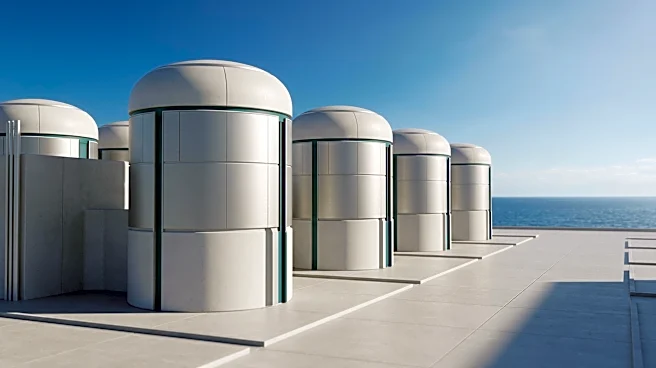
The immediate next steps involve the continued design and commissioning of the Advanced Research and Test Reactor at ISU’s Business and Research Park. The collaboration between Idaho State University and NuCube Energy Inc. will focus on bringing this innovative project to fruition. The project is expected to serve as a hub for student learning, applied research, and reactor operations, indicating a future emphasis on educational programs and research initiatives. As the project progresses, there will likely be further announcements regarding construction milestones, research outcomes, and educational opportunities for students. The success of this microreactor could also pave the way for similar projects nationwide, as it is recognized as the first of its kind. Additionally, the ongoing partnership with NuCube Energy Inc. suggests continued development in advanced nuclear technology, potentially leading to new applications for microreactors in providing carbon-free electricity and industrial heat.
Beyond the Headlines
The development of this microreactor at Idaho State University carries deeper implications beyond immediate energy production and workforce training. It represents a significant philosophical shift towards decentralized and modular nuclear energy solutions, which could fundamentally alter how power is generated and distributed in the U.S. Microreactors, being smaller and factory-built, offer enhanced flexibility and scalability compared to traditional large-scale nuclear plants, potentially enabling energy independence for remote communities or industrial sites. Ethically, this project underscores a commitment to addressing climate change through advanced, carbon-free energy sources, while also raising questions about nuclear waste management and safety protocols in a more distributed energy landscape. Culturally, it reinforces Idaho's historical connection to nuclear science and positions the state as a vanguard in the next generation of nuclear technology. The emphasis on training "great minds" suggests a long-term investment in intellectual capital, fostering a new generation of nuclear engineers and scientists who will shape the future of energy in the nation.