






What's Happening?
Eddie Murphy, a renowned comedian and actor, and Jamie Dimon, Chairman and CEO of JPMorgan Chase, are linked through the history of financial regulation, specifically concerning the 2010 Dodd-Frank financial reform law. In 2010, Commodity Futures Trading
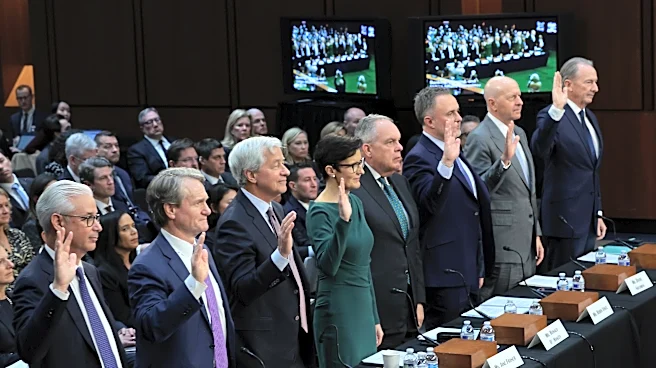
Commission Chairman Gary Gensler cited Murphy’s 1983 film 'Trading Places' to explain the need for stronger restrictions on trading with confidential government information. The film depicts a scheme involving frozen orange juice futures and a confidential government report, which inspired what Gensler called the 'Eddie Murphy rule.' This rule became part of Dodd-Frank, amending the Commodity Exchange Act to prohibit the misuse of nonpublic government information in commodities and derivatives markets. Separately, Jamie Dimon testified before Congress in 2012 regarding a derivatives-trading failure at JPMorgan Chase, known as the 'London Whale' incident, which resulted in at least $6.2 billion in losses due to breakdowns in risk management.
Why It's Important?
This connection highlights the unexpected ways popular culture can influence significant policy decisions and public discourse, particularly in complex fields like financial regulation. The 'Eddie Murphy rule' demonstrates how a fictional narrative can effectively communicate the importance of preventing insider trading and market manipulation, making abstract financial concepts relatable to policymakers and the public. For the financial industry, the Dodd-Frank Act, partly inspired by this cultural reference, imposed stricter regulations aimed at preventing future crises and protecting market integrity. Jamie Dimon's testimony on the 'London Whale' incident further underscored the critical need for robust risk management within financial institutions, impacting how banks approach derivatives trading and internal oversight. Both instances illustrate the ongoing efforts to balance market efficiency with regulatory safeguards to prevent systemic risks and protect investors.
What's Next?
The legacy of the 'Eddie Murphy rule' continues to shape regulatory approaches to market transparency and the prevention of insider trading in commodities and derivatives markets. Financial institutions remain under scrutiny to comply with Dodd-Frank provisions and maintain stringent risk management protocols, especially in complex trading activities. Future legislative efforts or regulatory updates may continue to draw on lessons learned from both fictional portrayals of market manipulation and real-world financial failures. The ongoing dialogue between regulators, financial leaders, and the public will likely focus on adapting existing frameworks to address new financial products, technologies, and market dynamics, ensuring that the principles of fair and transparent markets are upheld.
Beyond the Headlines
The 'Trading Places' connection to financial regulation reveals a deeper cultural phenomenon where art imitates life, and then life, in turn, is shaped by art. It underscores the power of storytelling, even in comedic form, to illuminate complex societal issues and drive policy change. This intersection of entertainment and governance suggests that public understanding and engagement with critical issues can be significantly enhanced through accessible narratives. Furthermore, the contrasting situations of a fictional market manipulation inspiring a rule and a real-world financial giant facing losses due to risk management failures highlight the persistent challenges in regulating sophisticated financial markets. It prompts reflection on how effectively regulations can anticipate and mitigate risks, and the continuous need for vigilance and adaptation in both policy and corporate governance.