







What's Happening?
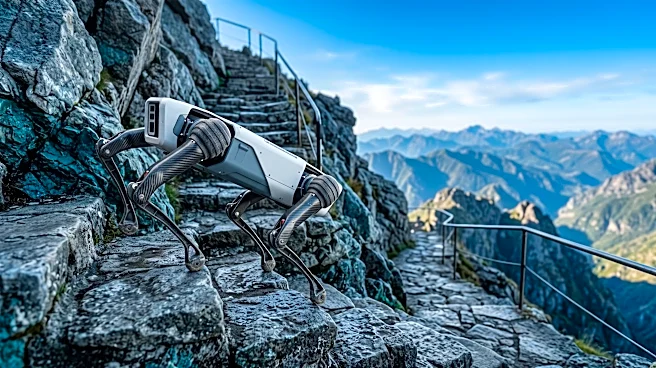
On November 2, China hosted the CMG World Robot Mount Tai Challenge in Tai'an, Shandong Province, where nearly 90 teams tested their latest robotics technology. Humanoid, quadruped, and exoskeleton robots navigated a 3.9-kilometer stretch of an ancient
mountain path, climbing 3,100 stone steps and gaining 600 meters in elevation. The route presented steep slopes, long stairways, and sharp bends, serving as a rigorous testing ground for robot mobility and stability in real-world, uneven terrain. Spectators observed as the machines attempted the ascent, with several successfully reaching the finish line. Some robots were tasked with carrying fragile cargo, such as eggs and watermelons, to the summit. The challenging conditions led to some robots falling, requiring repairs, while others, like a robot dog, navigated the rugged steps with apparent ease.
Why It's Important?
This competition is a significant indicator of the advancements and current limitations in robotics technology, particularly in the context of real-world deployment. The ability of robots to traverse difficult, natural terrain is crucial for applications beyond controlled factory environments, including disaster relief, exploration, and logistics in challenging landscapes. The event highlights the ongoing global race in robotics development, showcasing China's commitment to pushing the boundaries of what robots can achieve. The performance of different robot types, such as the more agile quadruped robots compared to some struggling humanoids, provides valuable data for engineers to refine designs and AI algorithms. The challenge also underscores the importance of robust navigation, balance, and object manipulation capabilities for future generations of robots, impacting industries that require autonomous operations in complex outdoor settings.
What's Next?
The insights gained from the Mount Tai Challenge will likely inform future research and development in robot mobility and AI. Engineers will analyze the performance data to improve robot designs, control systems, and learning algorithms, particularly for navigating uneven and unpredictable environments. The competition serves as a benchmark for progress, encouraging further innovation in areas such as dynamic balance, multi-contact locomotion, and adaptive path planning. Future iterations of such challenges may incorporate even more complex tasks or longer distances, pushing the limits of robotic endurance and autonomy. The focus will remain on developing robots that can reliably perform tasks in diverse, real-world conditions, moving beyond controlled laboratory settings to practical applications in various industries.
Beyond the Headlines
Beyond the immediate technical challenges, events like the Mount Tai Challenge contribute to public perception and understanding of robotics. Showcasing robots tackling such a demanding physical feat can inspire future generations of engineers and scientists. It also subtly addresses the broader societal implications of advanced robotics, demonstrating their potential for tasks that are difficult or dangerous for humans. The contrast between the struggling humanoid robots and the more successful quadruped robots highlights the ongoing debate and development in robot form factors and their suitability for different tasks. This competition, held at a UNESCO World Heritage site, also subtly intertwines technology with cultural heritage, presenting a unique blend of ancient landscapes and cutting-edge innovation, which could spark discussions about the integration of advanced technology into traditional environments.