
What's Happening?
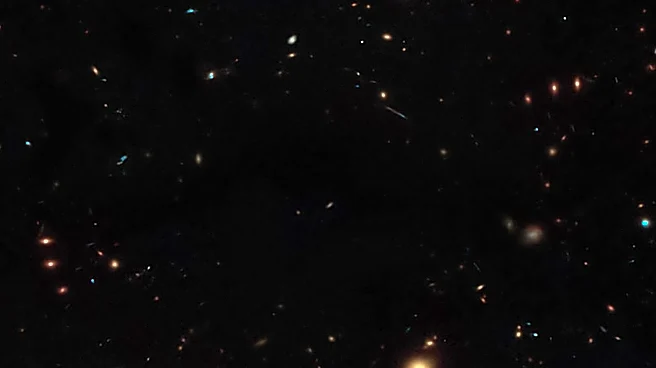
An international team of astronomers, utilizing the Gemini North telescope and the James Webb Space Telescope (JWST), has discovered Nāpōwawāʻenakaulua, the oldest and most compact pair of quasars ever
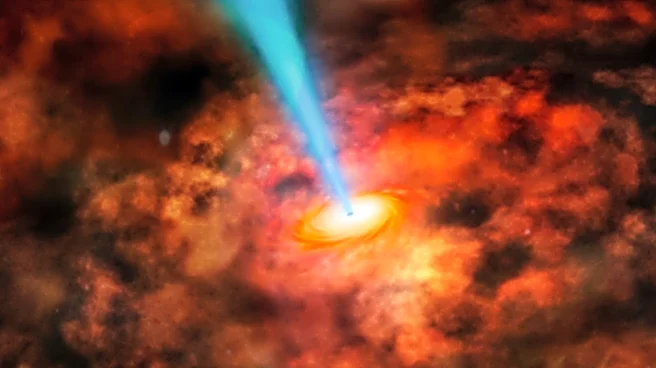
observed. This quasar pair exists just 900 million years after the Big Bang, a period known as cosmic dawn. The discovery challenges current scientific understanding because the supermassive black holes within this pair are as massive as those seen today, an unexpected finding for such an early stage of the Universe's development. The pair, separated by approximately 18,100 light-years, consists of two supermassive black holes with masses of 1.5 billion and 400 million times that of the Sun, respectively. Silvia Onorato, a postdoctoral research associate at NSF NOIRLab, led the study, which was published in The Astrophysical Journal Letters. The discovery was made during visual inspections of data from the Aether survey, a JWST program aimed at cataloging objects in the early Universe.
Why It's Important?
The discovery of Nāpōwawāʻenakaulua is significant because it directly contradicts existing theoretical models for the formation and growth of supermassive black holes and large-scale cosmic structures in the early Universe. Scientists currently lack a definitive explanation for how such massive quasars could have formed so early in cosmic history, let alone a pair of them. This finding suggests that the conditions in the early Universe might have been more conducive to rapid black hole growth and galaxy formation than previously thought. It provides astronomers with a unique 'laboratory' to study the assembly of the first massive galaxies and their central black holes through direct galaxy interactions during these formative times. The data collected from this observation will be crucial for refining cosmological models and understanding the fundamental processes that shaped the Universe.
What's Next?
Further observations and theoretical work will be necessary to fully understand the implications of Nāpōwawāʻenakaulua. Researchers will likely focus on developing new theoretical models that can account for the rapid growth of these supermassive black holes at such an early epoch. The team proposes that this rare quasar pair may indicate an extreme peak in the matter density field of the early Universe, where galactic interactions simultaneously fueled star formation and black hole growth. Future studies may involve more detailed spectroscopic analysis to better characterize the environment surrounding these quasars and search for similar objects to determine if Nāpōwawāʻenakaulua is an anomaly or part of a larger, previously unobserved phenomenon. The ongoing Aether survey and other JWST programs will continue to search for more such objects, which could provide additional data points to refine our understanding of cosmic dawn.
Beyond the Headlines
This discovery has profound implications for our understanding of cosmic evolution and the fundamental laws governing the Universe. It challenges the completeness of current cosmological theories, potentially indicating gaps in our knowledge about the initial conditions of the Universe or the mechanisms of matter accretion and energy conversion in extreme environments. The existence of such massive structures so early in cosmic history could suggest that the Universe's initial density fluctuations were more pronounced than current models predict, or that alternative pathways for black hole growth, such as direct collapse, were more prevalent. Furthermore, the naming of the quasar pair, Nāpōwawāʻenakaulua, through the A Hua He Inoa program, highlights the intersection of scientific discovery with cultural heritage, integrating indigenous Hawaiian language and concepts into modern astronomical nomenclature. This practice enriches the scientific narrative by connecting it to diverse human perspectives on the cosmos.